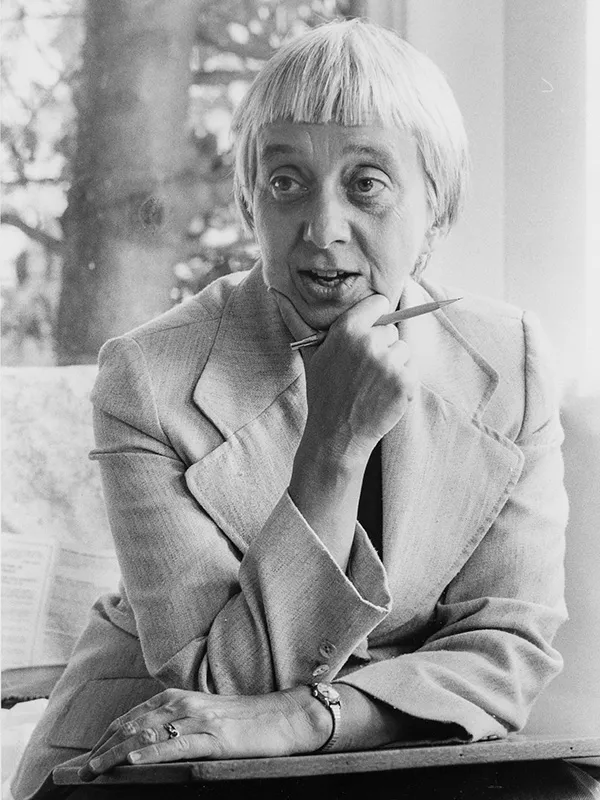
Ann Fagan Ginger, ’47, died on August 20 at her home in Berkeley, California, just weeks after celebrating her 100th birthday.
She was one of only eight women in her law school class. When law firms wouldn’t hire her, she began her career as an administrator at the National Lawyers Guild. She was blacklisted when she and her then-husband, Harvard professor Ray Ginger, refused to sign oaths swearing they were not and never had been affiliated with the Communist Party.
She spearheaded efforts to dismantle McCarthyism, including arguing and winning the case Raley v. Ohio before the US Supreme Court, upholding the due process rights of a target of Ohio’s Un-American Activities Committee. Eventually, Fagan Ginger moved to Berkeley, where she “quickly established herself as a force in the left-leaning legal community around the Bay Area,” according to the New York Times. She launched the Civil Liberties Docket, an archive of civil rights litigation that became an essential resource for lawyers and activists nationwide.
In 1962, she was the only woman lawyer at the first desegregated meeting of attorneys in the South. There, she was photographed alongside the Rev. Martin Luther King Jr. and other civil rights leaders, speaking in favor of the movement and predicting the coming women’s rights movement. In 1965, she founded the Meiklejohn Civil Liberties Institute, naming it after a First Amendment scholar whose advocacy during the Cold War she deeply admired.
She also pioneered the integration of public international law, military law, and constitutional law into what she termed “peace law,” a legal innovation that helped secure acquittals for nuclear weapons protesters and other activists. She authored or edited two dozen books; her scholarship emphasized the enforceability of international human rights treaties in US courts.
She is survived by her son James Ginger, of Berkeley.