For Jennifer White Callaghan, ’04, the path to a career in human rights law began in an unlikely place: the derivatives desk at some of the world’s biggest banks.
Today, Callaghan is a senior pro bono lawyer at A&O Sherman, where she co-leads the pro bono program for the firm’s US offices. She manages immigration matters involving refugees and asylum seekers, with a particular focus on Afghans seeking protected status in the United States. She also works on human rights and civil rights cases and connects lawyers across the firm with nonprofit organizations and individuals who need legal assistance.
It’s a role that Callaghan describes as the best job in the world—and one that builds on her lifelong interest in human rights work and her decades of experience in finance and the law.
A winding path
After earning an undergraduate degree in history and economics and a master’s in government at Harvard and the University of Pennsylvania, respectively, Callaghan went into finance and worked for major banks as a derivatives trader. It was a relatively new field at the time, and the work took her to Hong Kong, London, and Singapore. She enjoyed the pace and novelty but eventually began looking for something new.
Law school had always appealed to her. Her stepmother, Patricia White, ’74, was a professor at the Law School in the 1980s and early ’90s, and Callaghan grew up with law and legal education as part of everyday life. She also had a longstanding interest in human rights, including service as a trustee of Doctors Without Borders. At Michigan Law, she pursued international and human rights-related coursework and joined Allen & Overy in London after graduation.
There, Callaghan spent 17 years developing the experience that would ultimately prepare her for full-time pro bono work. Her primary practice was transactional, with a focus on capital markets and derivatives. But she continued to pursue pro bono matters alongside her billable work, finding ways to apply her financial expertise to social impact projects. She worked on microfinance transactions and explored how financial markets could be used to address humanitarian challenges.
Her projects included a very early social finance structure designed to fund programs aimed at reducing recidivism among people released from Peterborough Prison in England, as well as an effort to use commodity derivatives to help manage the cost of food purchased for humanitarian relief.
That combination of transactional experience alongside years of pro bono work became critical when Callaghan moved into the pro bono group full time in late 2019.
Jennifer White Callaghan, ’04I get goosebumps just thinking about all of the people we support, whatever stage they are in their process. [We do this work] so that human beings can have a regular life that they like.
Helping immigrants find a new home
More recently, much of Callaghan’s work has been on behalf of Afghans seeking asylum or refugee status, particularly as applications have risen following the US withdrawal from Afghanistan in 2021.
“One of the first Afghan clients we took on in early 2021 worked with US forces in Afghanistan, and he had been attacked by the Taliban and was in real danger. We helped him through the application process, and he eventually got his green card to come here with his wife and kids,” she says.
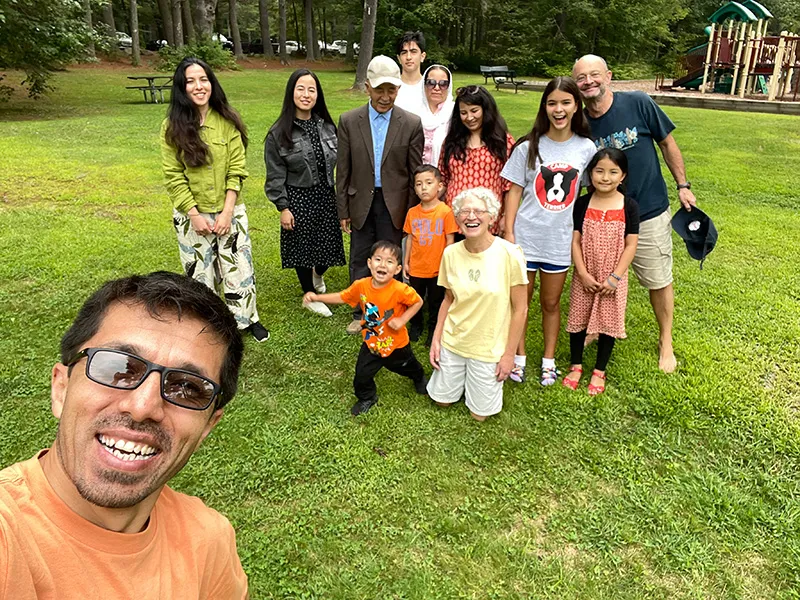
Callaghan and her colleagues later advised his sister on her asylum claim and went on to help his parents and three other siblings. The family now lives in the United States, and Callaghan and her family visit them for annual summer picnics, where all the kids—including his daughter and hers—play soccer together.
“They get to be regular people in their community and have friends and do the things that we all take for granted, and that’s really cool,” Callaghan says. “I get goosebumps just thinking about all of the people we support, whatever stage they are in their process. It’s why we do this work collaboratively, innovatively, and thoughtfully—so that human beings can have a regular life that they like.”