
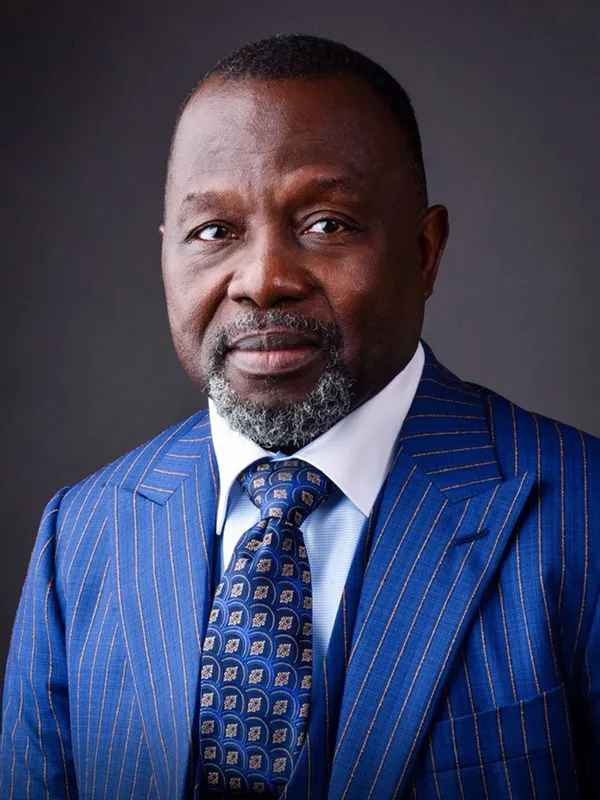
Despite humble beginnings, Dominic Akuritinga Ayine, LLM ’98, has risen to the rank of attorney general and minister for justice in Ghana.
The small town of Zuarungu, situated on the savannah grasslands of northeast Ghana, is about as far from Accra, the dynamic capital city, as you can get in this West African country.
It was here that Dominic Akuritinga Ayine, LLM ’98, grew up. As a shepherd in his youth, he did not consider formal education to be an option until an encounter with a catechist in his Catholic church changed his life’s trajectory. When the teacher asked why he wasn’t in school, Ayine—then 11 years old—replied that his family could not afford a school uniform.
“A few days later, he appeared at our doorstep and told my mom that he thought I was a brilliant chap and yet I was not attending school. So he paid for my uniform in order for me to go to school,” Ayine says. “I always mention him as my hero. If not for him, I wouldn’t be sitting here today.”
While Ayine was the oldest student in his initial class—“they used to call me the class’s ‘old man’”—he quickly advanced and graduated from secondary school before proceeding to college. Decades later, Ayine has had a career that has allowed him to pay it forward as he reached the highest levels of the Ghanaian government, first as a member of parliament (MP) and now as attorney general and minister for justice.
Running for office
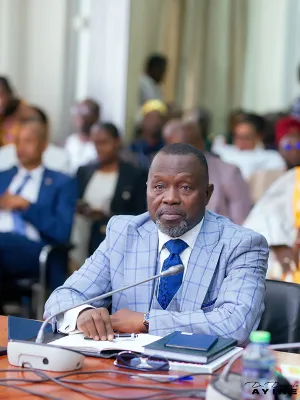
Ayine’s political career started in 2012, when he was elected to parliament to represent the Bolgatanga East District, the region where he grew up. Up until that time, he had taught at the University of Ghana— the same university where he earned his bachelor of law degree—and founded the law firm Ayine & Felli (now Ayine & Partners), where he focused his practice on oil and gas law, commercial disputes, international trade advisory services, and trial and appellate criminal defense. His legal education also included an LLM from Michigan Law and an LLM and JSD from Stanford Law School.
His turn to politics began when the National Democratic Congress party took note of an amicus brief he had submitted to the Supreme Court in a case concerning the creation of constituency boundaries (similar to redistricting in the US).
“The Supreme Court actually relied upon my amicus brief,” says Ayine. “The justices quoted me extensively and said that I had brought the best arguments to the court.”
He was elected MP to represent a newly drawn district and was reelected in 2016, 2020, and 2024. In addition to leading the Constitutional Committee in parliament, where he helped pass legislation dealing with governance, he also chaired the Legislation Committee in charge of regulations.
He also focused on giving back to his constituents, ensuring improvements to his community that included connecting several towns to the national electrical grid and providing potable water. Along the way, he heard from constituents about their needs, including from some constituents very close to home about the need for a modern market center.
“Markets are a very, very important part of the economic life of towns in Ghana,” Ayine says. “We had a local market where my mother used to be a petty trader, and it was unchanged from the time I was a child. When I became a member of parliament, my mother and my aunties reminded me that this was a very important thing that they wanted me to do, to build a modern market.”
He successfully lobbied the minister of trade to build a modern market for the town. He also hopes to build a library that will make it easier for children to access books, remembering the 5-kilometer walks he took as a child to borrow books from the Bolgatanga Central Library.
Appointment as attorney general
Ayine’s career took a turn in 2018 when he was appointed deputy attorney general on top of his role as an MP. The deputy position, which he held for four years, helped prepare him for his current job as attorney general and minister for justice, for which Ghana President John Mahama nominated him in February 2025.
Under constitutional directive, Ayine is the principal legal adviser to government ministries, departments, and agencies as well as the president and his cabinet. He also oversees approximately 300 attorneys throughout the country.
Additionally, he argues on behalf of the government in Supreme Court cases and is in charge of prosecutions instituted in the name of the republic. Since coming to office, he has investigated a number of white collar crimes, including a former government employee accused of diverting funds from a $7 million cybersecurity contract. The case is part of a larger anti-corruption effort by the government.
“I’m very passionate about accountability and fighting corruption,” Ayine says, “because it has an adverse impact on government when public funds are siphoned into private pockets—and then the public suffers as a result.”

He also is working on a piece of legislation, he says, to “radically shake up the legal education system [and] create equality of opportunity for all persons who are desirous of becoming lawyers, to the extent that they have the academic acumen to be able to pass their exams, to do their bachelor of laws, and then subsequently to sit for a national bar exam.”
With such a large portfolio, Ayine doesn’t have much time to focus on the future and prefers to seize opportunities as they arise—just as he did when he was offered the opportunity to attend school at 11 years old.
“My approach to life has always been to do one thing at a time,” he says. “It doesn’t mean that I do not have any ambitions, but I just want to do what I’ve been given now and let the public see for themselves who I am and what I stand for. And if there’s any way for me to progress from here, I will make that decision when I get to that point. So I will do my best, and I leave the rest to God.”