An old photograph sent Eddie Mears, ’16, on a trans-Pacific quest to learn more about a friendship between his grandmother and a Chinese student in 1930s Ann Arbor.
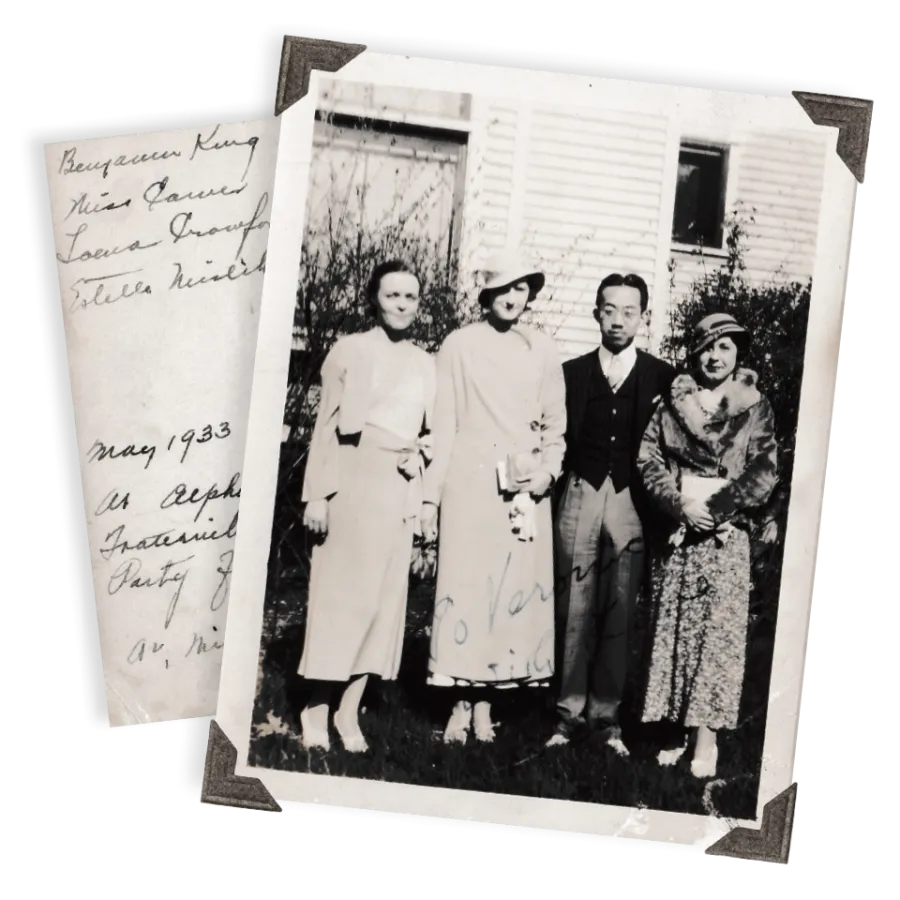
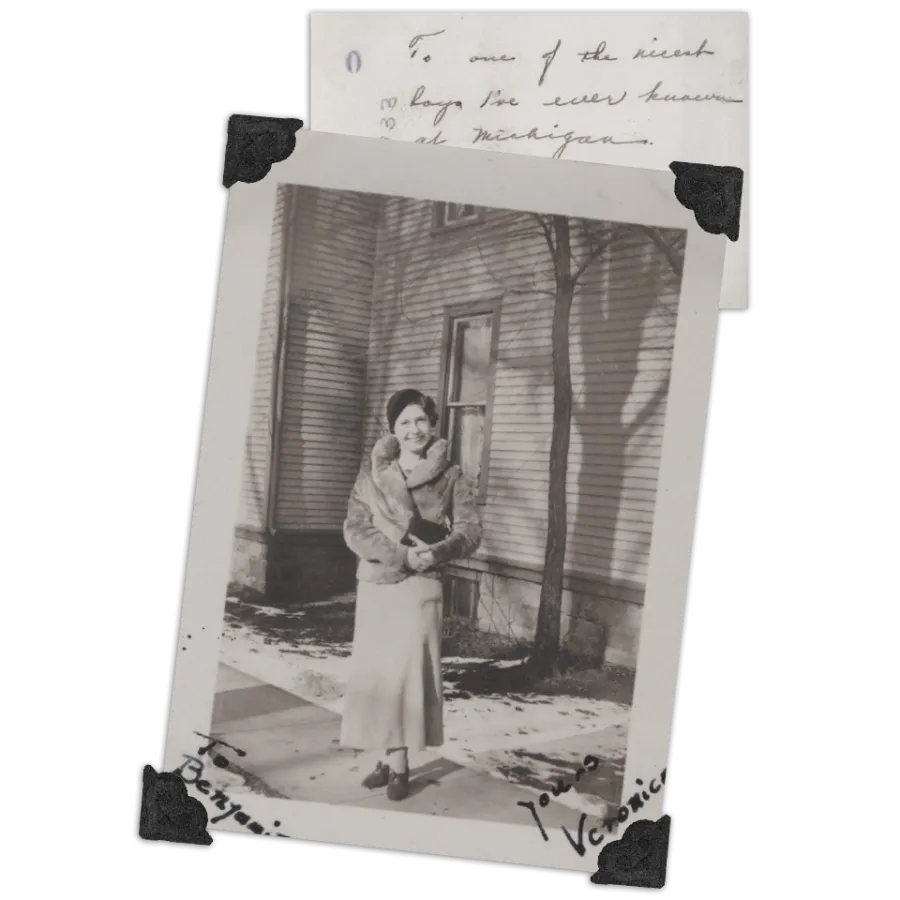
In 2022, while visiting the United States with my father, Patrick Mears, BA ’73, JD ’76, I discovered a box of my late grandmother’s belongings that opened a window into an aspect of her life I had never known. Inside was a faded photograph of a young Chinese man standing beside my grandmother in front of the former Alpha Lambda Chinese fraternity at 1402 Hill Street, Ann Arbor. The photo had been taken in May 1933. Across the bottom, he had written, “To Veronica, with love, Ben.” On the back she had written his full name, “Benjamin King.”
My grandmother, Estelle Veronica Mislik Mears (1909–1992), was the daughter of poor Polish immigrants who settled in Flint, Michigan. She was the first in her family to attend college—specifically, the University of Michigan—and later became a teacher in Detroit and Flint. I knew her only briefly, as a loving grandmother who encouraged my sister and me to read.
In the time that I knew her, I was too young to inquire about her college years or her Asian friend. But Benjamin’s image hinted at a friendship that crossed national, racial, and political lines during a volatile period of history.
As a lawyer and long-term resident of Tokyo, I immediately became intrigued. Who was Benjamin, and what had become of him? That pursuit, which was equal parts personal odyssey and historical investigation, would transport me from U-M’s Bentley Historical Library to the streets of Shanghai and Hangzhou. Along the way, my Michigan Law training and my subsequent career as a corporate attorney proved invaluable in piecing together the story of an unlikely friendship between my grandmother and a Chinese law student in 1930s Ann Arbor.
The Michigan connection
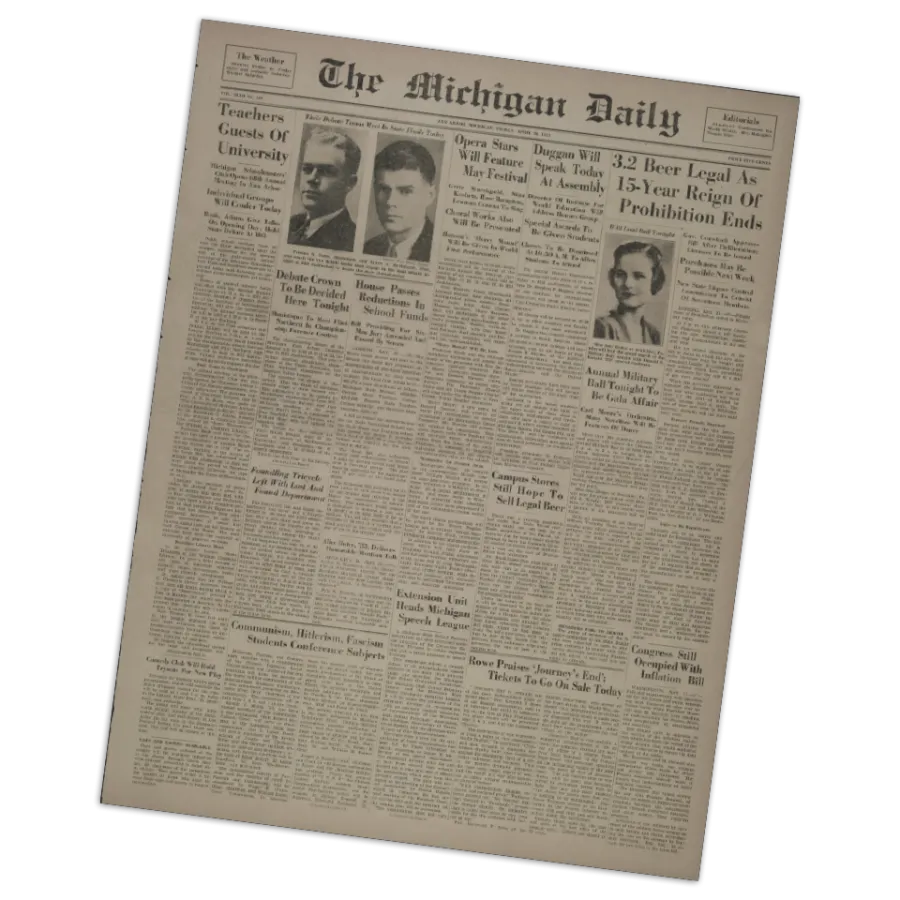
My search began in the Michigan Daily's digital archives. Articles from the early 1930s mentioned a Chinese student named Benjamin King, including a series covering the 1933 International Students Conference on World Affairs, held in the Michigan Union Ballroom. For four days, students and professors debated the rise of Nazism, American-Soviet relations, and the Sino-Japanese conflict, adhering to a procedure modeled on the League of Nations. The Daily recorded that the chair of the conference’s World Politics Commission was Benjamin King, while the secretary was my grandmother, Estelle.
This academic connection likely established the foundation of their friendship. It also recast my grandmother, whom I had only known as a provincial schoolteacher, as a campus leader engaged in international issues. Yet the newspaper articles offered little about Benjamin himself. Who was he? And where did he go after Ann Arbor?
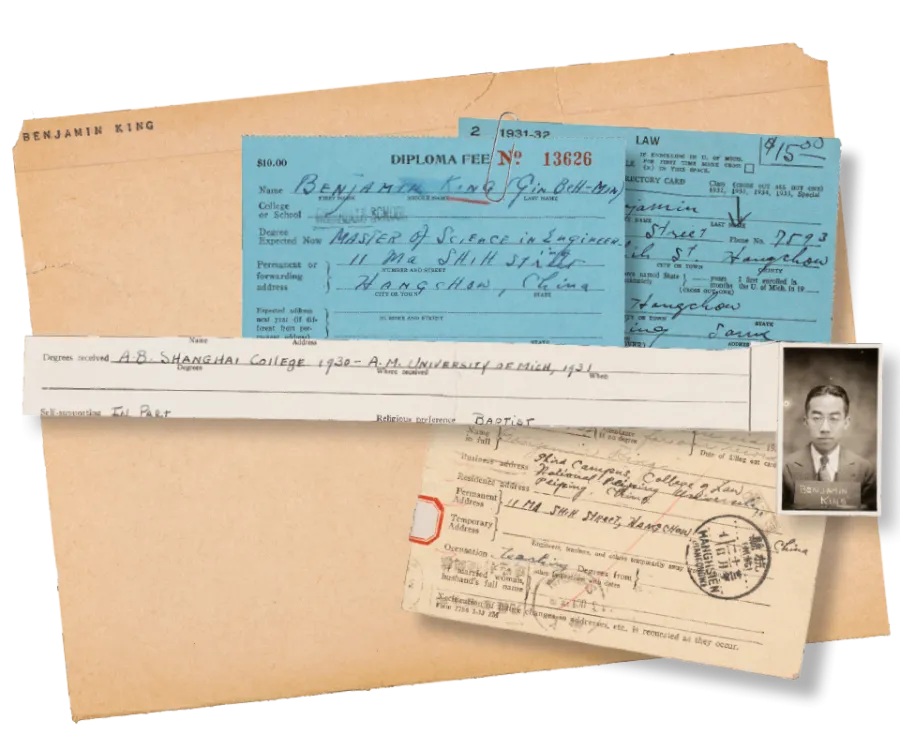
At the Bentley Library, I unearthed his student record. It revealed that Benjamin King was the anglicized name of 金伯铭 (Jīn Bó Míng), born in Hangzhou, China, in 1907 or 1908. The son of a merchant, he arrived at Michigan in 1930, earned a master's degree in municipal administration in 1931, and then enrolled in the Law School for the 1931–1932 academic year. Benjamin ultimately earned a master of science in engineering in 1933 and returned to China soon thereafter. He was active in both the Chinese Student Club and the Alpha Lambda fraternity. His emergency contact listed a Baptist pastor in Hangzhou, hinting at his religious background.
Even from these dry administrative forms, a portrait began to emerge of a thoughtful, principled young man deeply interested in law, governance, and international affairs.
Lawyer detective
Although the project began as a family curiosity, I soon realized how closely my legal training shaped my approach to this research. As a corporate attorney advising foreign investors in Japan, I spend much of my professional life piecing together incomplete records, drafting from fragments, and searching for coherence amid complexity. The same mindset guided my search for Benjamin.
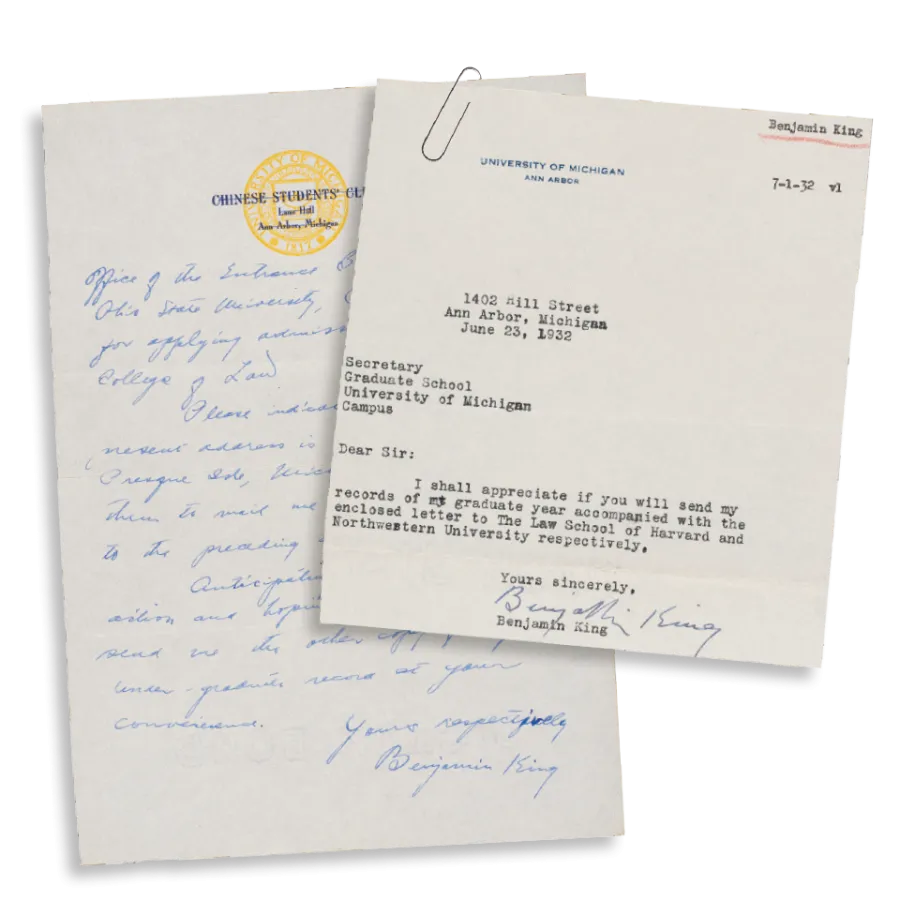
I began tracing Benjamin’s paper trail: old university bulletins, Rotary Club rosters, and alumni postcards. The Bentley file included letters requesting that his transcripts be sent to several US law schools and to the Shanghai Municipal Council, which indicated to me his ambition for a legal or administrative career back home.
It also struck me that, at a time when few American students socialized with their foreign peers, my grandmother and Benjamin had formed a genuine friendship built on shared curiosity about the world. She was a first-generation woman from Flint, navigating an elite university setting; he was one of a handful of Chinese students on campus. Both were outsiders with cosmopolitan aspirations. Perhaps this is how and why they found each other.
From Ann Arbor to Shanghai
Once I had exhausted Michigan's archives, I turned to China. Using AI translation tools and help from Chinese colleagues, I began combing through digitized Republican-era newspapers and banking directories. In 2024, I traveled to Shanghai and Hangzhou several times to trace Benjamin’s footsteps.
There I learned that after returning to China, Benjamin briefly taught law at Peking University before becoming employed by the National Commercial Bank of China in Shanghai, where he rose to the position of sub-manager. In 1940, he published one of the country’s first Chinese-language textbooks on modern banking practices. He was a member of the Rotary Club and vice president of the University of Michigan Alumni Club of Shanghai from 1939 to 1940, during the Japanese occupation.
The traces of his life are still visible in China. The Art Deco building near the Bund where he worked as a banker survives, as does his former address in the former French Concession. I walked these neighborhoods, imagining him balancing his Western education and Chinese identity during one of the most turbulent decades in modern history. In Hangzhou, part of his old Baptist high school, the Huizhou (Weyland) School, still stands.
Through these discoveries, Benjamin’s life began to entice me: He was no longer just a name on the back of a photograph but a man who carried his Michigan education back to a country on the brink of transformation.
Finding his family
Even so, many questions remained. Had Benjamin survived the political upheavals that followed 1949? Did he have descendants? The language barrier made progress slow until a Chinese colleague—who serendipitously happens to be a popular debater and key opinion leader— offered to share my research on her Weibo, China’s equivalent of Twitter.
My grandmother’s story went unexpectedly viral. Within days, journalists and television producers reached out, offering to help. Phoenix Television, a Chinese satellite television network, produced a half-hour documentary about my quest, Searching for Benjamin King, which aired in early 2025.
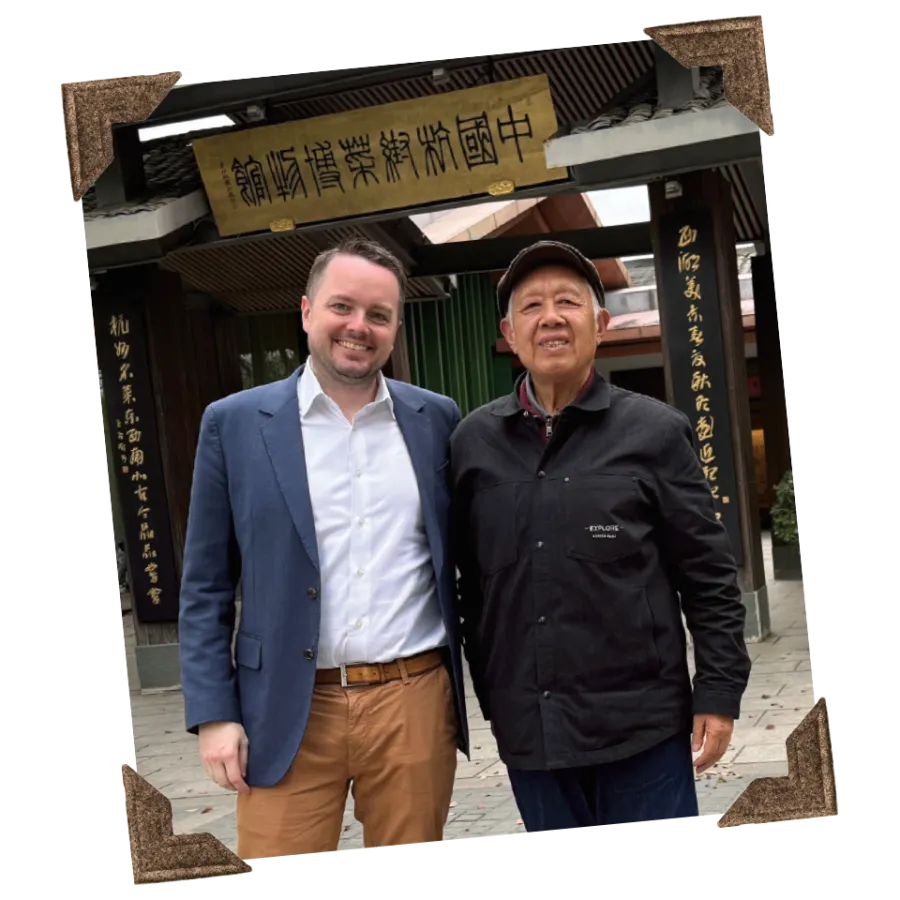
That visibility led to the breakthrough I had long hoped for. In March 2025, I returned to Hangzhou and met Benjamin’s 84-year-old relative, Kainan Jin. Over a dinner of braised beef and some of Benjamin’s other favorite delicacies, Kainan Jin shared stories about his Benjamin’s quiet life in Shanghai after 1949. He showed me an email from Benjamin's daughter, describing how he always stirred his morning coffee with a spoon engraved “The University of Michigan League.” Because men during Benjamin’s Ann Arbor sojourn could not enter the League without a female escort, and because my grandmother was known to frequent the League, I can’t help but wonder: Did she give him that spoon?
After returning to Japan, I thought the search had reached its natural end. Then, just weeks later, a friend who owns an antiques shop in Shanghai’s former French Concession contacted me. He had located a collector who had come into possession of Benjamin’s old photo album.
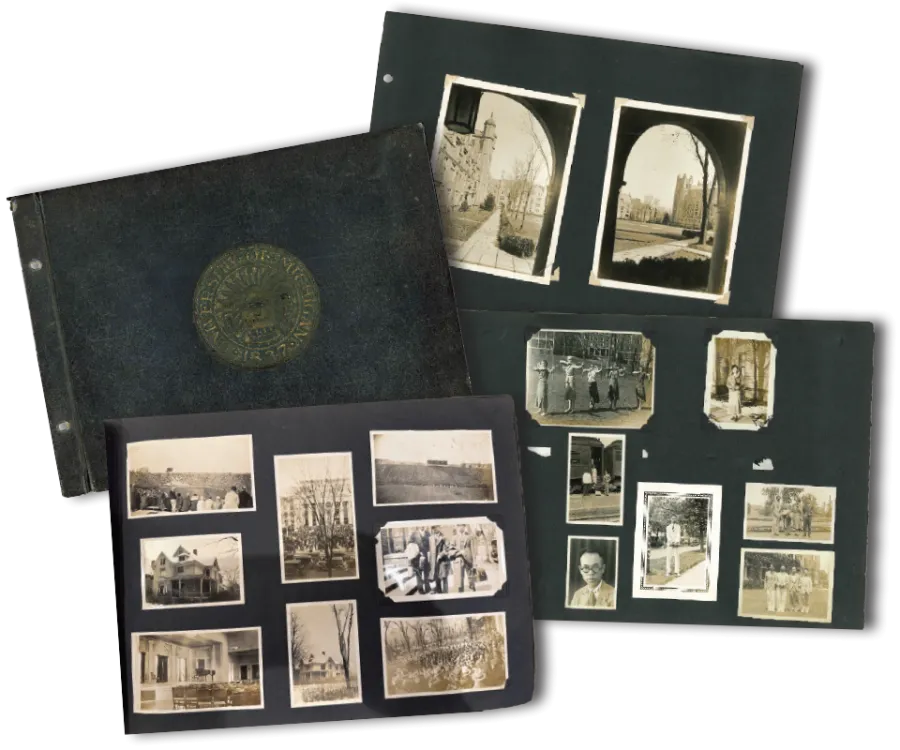
Emblazoned with the University of Michigan seal, the album contains candid snapshots of campus life: classmates in the Law Quad, football games at the Big House, and photos of Benjamin’s fraternity brothers. Most moving were two photographs of my grandmother: one in a cap and gown and another in a dress and coat, both dated March 1933. On the front of the second photo she wrote, “To Benjamin, Yours, Veronica.” On the back, in neat cursive, “To one of the nicest boys I’ve ever known at Michigan.”
That this album survived wars, the Japanese occupation, and the Cultural Revolution before resurfacing in 2025 is nothing short of miraculous.
Reflections on the search
Benjamin King’s story is both extraordinary and familiar. Extraordinary because it reveals the truly global reach of Michigan even in the 1930s and how friendships formed in Ann Arbor could ripple across continents. Familiar, because it reflects a shared Michigan experience: curiosity and the pursuit of understanding.
The process drew me closer to a grandmother I hadn’t had the chance to know well, and it breathed new life into a chapter of her story that time had almost forgotten. Most of all, it reminded me of the power of unlikely friendships: between a first-generation Polish-American woman from Flint and a Chinese exchange student from Hangzhou, two outsiders who found common and friendly ground at Michigan during an age of isolationism.
Eddie Mears, ’16, is a senior associate in the Tokyo office of DLA Piper, where he practices corporate law with a focus on the sports, media, and entertainment sectors. He has lived and practiced in Asia (Japan and Singapore) since graduating from Michigan. View the documentary Searching for Benjamin King on Youtube.