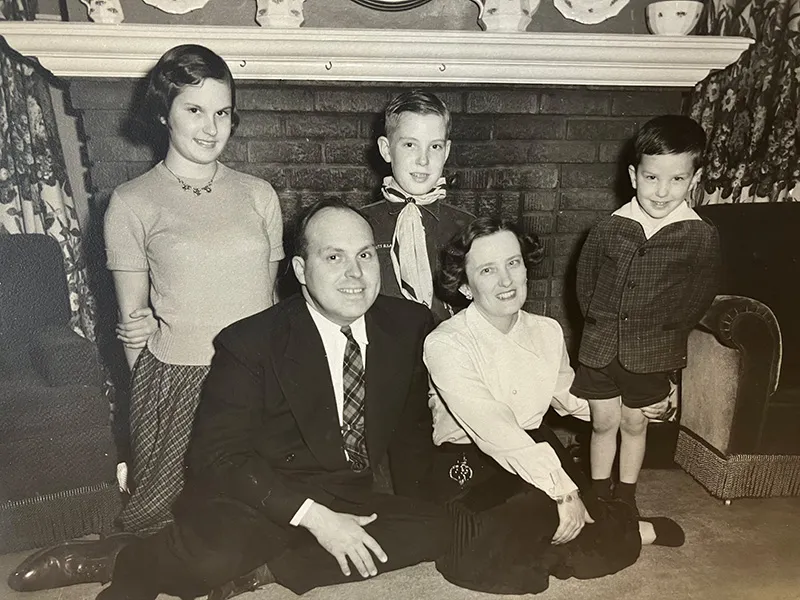
For Charles “Charley” Knox, ’73, spending time at his father’s law office in downtown Erie, Pennsylvania, was a typical part of childhood. He never considered an alternative career path for his future; becoming a lawyer was always his plan.
Knox’s parents met as undergraduates at the University of Michigan. Both became double Wolverines and had four children together, each of whom went on to earn one or more degrees from the University.
“My mom was from Ann Arbor, and my siblings and I visited the area a lot growing up,” he says. “My grandfather owned a bookstore in town, we’d attend football games, and, given that my father had gone to Michigan Law, I certainly had a favorable impression of the school.”
Although Knox earned his undergraduate degree from Williams College in Massachusetts—the only family member to not attend U-M as an undergrad—his choice for law school was clear.
Finding his path
When he began his studies at Michigan Law in the fall of 1970, the Vietnam War loomed large. Knox was assigned a draft number under the lottery system and allowed himself to commit to his studies only when it became clear his number wouldn’t be called.
“That first semester, I was more distracted than I might have been because of the uncertainty,” he says. “All I could do was question whether I’d be able to finish law school in a regular sequence.”
In his second semester, feeling secure in his path forward, Knox focused more on his coursework, formed close friendships with his classmates, and joined the Law School’s intramural basketball team.
Knox’s plan to join the family firm was scuttled when President Richard Nixon appointed his father to the federal bench. As a pivot, he began interviewing with different Pittsburgh-based firms that visited Michigan Law and secured a position at Buchanan Ingersoll & Rooney PC upon graduation.
“I was pretty much the garbage man when I was starting out at the firm, and I worked on practically everything, including trial work,” he says. “But specialization accelerated in the early years of my career, and eventually I developed a practice focused on real estate and banking.”
In time, he began working as outside real estate lending counsel for a regional bank headquartered in Pittsburgh, a role he maintained for the remainder of his career. He retired at the end of 2016.
Charles Knox, ’73Being a donor to the Law School is largely inspired by the relationship I had with my dad. He loved the school and the education he received, and it meant a lot to him to give back. Becoming a donor was another way I could honor him.
Investing in the future
Knox recently gave $200,000 to the Law School in honor of his father, William W. Knox, ’35, using two charitable gift annuities (CGAs), a type of legacy gift. The gift establishes the Honorable William W. Knox Family Endowed Scholarship Fund.
“Being a donor to the Law School is largely inspired by the relationship I had with my dad,” says Knox. “He loved the school and the education he received, and it meant a lot to him to give back. Becoming a donor was another way I could honor him.”
CGAs allow donors to support the Law School while also receiving a fixed income for life. Additional forms of legacy gifts include bequests, charitable remainder trusts, or naming Michigan Law as a beneficiary of a retirement account.
“Giving through CGAs enabled me to make a larger donation than I might have otherwise made because it provides me with some financial security and diversification of where my income stream is coming from,” says Knox. “I established one through my undergraduate alma mater and have had a great experience, so I knew it was the right giving vehicle for my contribution to the Law School.”