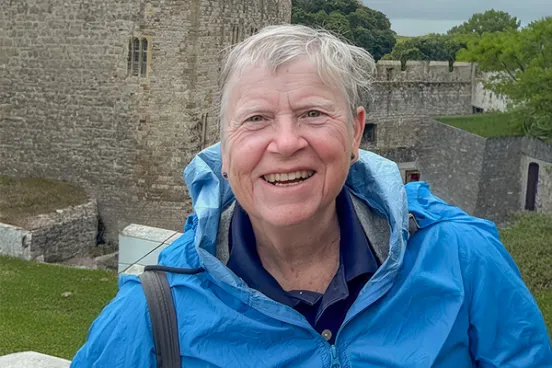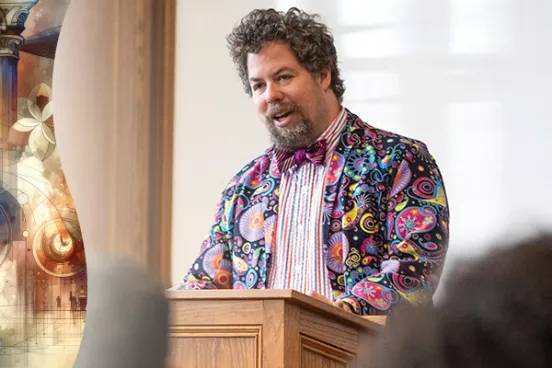
108 episodes of the video series A2Z have been published as of October 2025. When the pandemic shut down in-person prospective student events in 2020, Senior Assistant Dean Sarah Zearfoss, ’91, took to YouTubing from her basement. Five years later, A2Z, a video series that demystifies the admissions process, continues to help prospects put their best application forward (even if they end up not applying to Michigan). The most-watched episode is season 2, episode 12, “Soft Factors That Will Make or Break Your Application,” with 82,000 views. Check out A2Z on YouTube at @umichlaw.
Bucket List
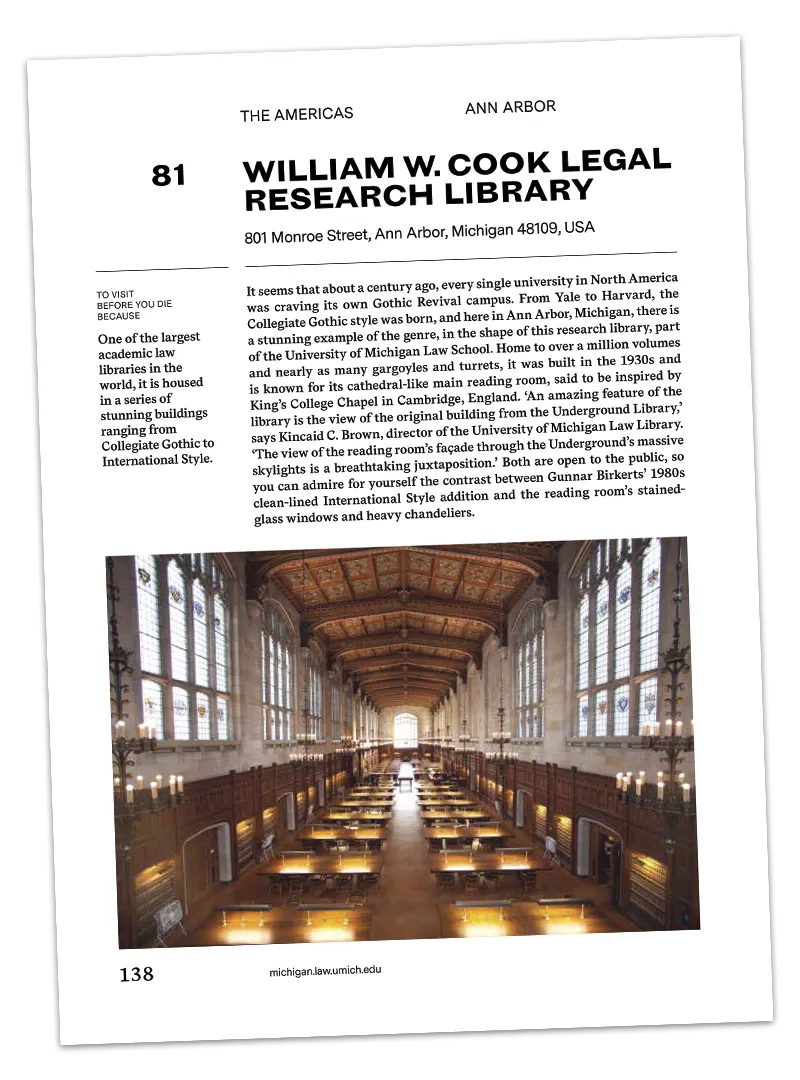
The William W. Cook Legal Research Library was included in 150 Libraries You Need to Visit Before You Die by Léa Teuscher, a London-based writer who researched and wrote the book for Belgian publisher Lannoo.
“One of the largest academic law libraries in the world, it is housed in a series of stunning buildings ranging from Collegiate Gothic to International Style,” she wrote.
“Ohio State is arguing primarily that the Brown Jug’s use of ‘Buckeye Tears’ as a trademark will confuse consumers who will erroneously believe that Ohio State licensed, sponsored, or is otherwise connected with Brown Jug’s products. It is also arguing that the Buckeye mark is a very famous mark, so any business’s use of a mark with ‘Buckeye’ in it will damage the distinctiveness of its marks.”
—Jessica Litman, the John F. Nickoll Professor of Law, in a Michigan Daily story about a notice of opposition that Ohio State University filed in response to the Brown Jug restaurant’s trademark application for its beer Buckeye Tears. The restaurant submitted an initial answer to the notice in October, stating that “Buckeye Tears” refers to the sentiment that “Ohio State and its supporters may on occasion act like sore losers.” The Brown Jug’s legal team includes Todd Gregorian, ‘04, who is handling the case pro bono.
AI, the Future of the Legal Profession, and You
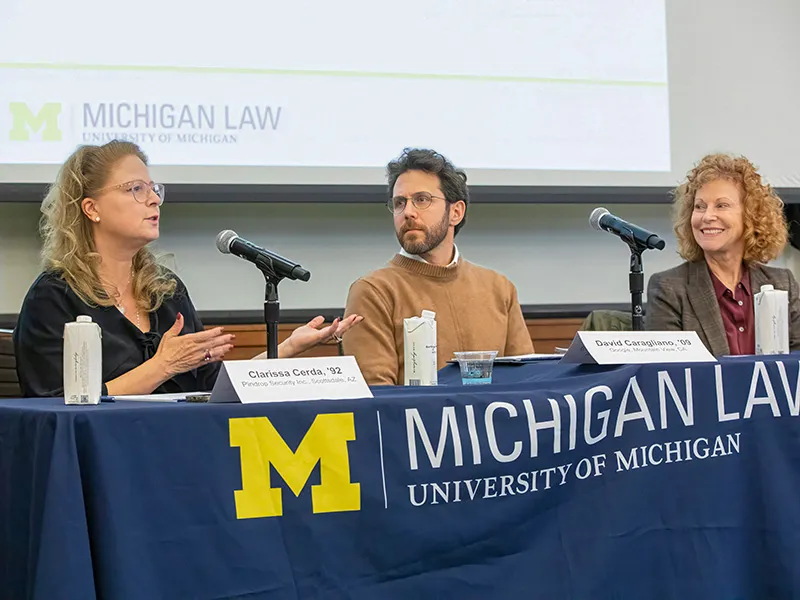
Alumni spoke to a packed house at “AI, the Future of the Legal Profession, and You” in October. Panelists were (left to right) Clarissa Cerda, ’92, chief legal officer and secretary at Pindrop Security Inc.; David Caragliano, ’09, global head of ads safety at Google; and Mary Snapp, ’94, former vice president of strategic initiatives at Microsoft. Ashish Prasad, an adjunct professor and vice president and general counsel at HaystackID, moderated the event.
Tea for…Four
Ginny Miller (seated, right) cashed in her Student Funded Fellowships Auction prize, “Afternoon Tea with Professor McCrudden and His Wife, Caroline,” earlier this fall. Joining her were (clockwise from front) Shannon Hickey, Ellen Chirikos, and Aoife Bennett. The foursome enjoyed tea and goodies made by Caroline, which included cucumber sandwiches, scones, chocolate chip pound cake, strawberries and cream, and pie.

“We chatted in detail about Ireland (notably Derry Girls), Caroline’s incredibly interesting career as a tropical botanist, Professor McCrudden’s class on Human Dignity, and a bunch of other things,” says Bennett. Christopher McCrudden is an L. Bates Lea Global Law Professor at Michigan Law, a professor of human rights and equality law at Queens University Belfast, and a practicing barrister-at-law with Blackstone Chambers.
103 Alumni from 58 Firms
networked with 1Ls during Big Law at the Big House in September. The annual event, hosted by the Office of Career Planning, provides students an early opportunity to explore practice areas and learn to differentiate between them without the pressure of summer recruiting.
[R]egulatory models give social media companies more power than we would typically expect of other private entities in relation to speech. Treating them as quasi-state actors would also relieve states of accountability for the things happening on social media.
—Current SJD candidate Mike Tiu Jr., LLM ’25, one of two students who won 2025 Kouba Prizes for outstanding papers on European Union law or on international peace and security among nations. Tiu, a law professor at the University of the Philippines, argued that social media companies should be treated as quasi-state actors rather than private entities to hold them accountable for protecting human rights, especially as the need for regulations across social media channels evolves alongside the emergence of new technologies. Isobel Blakeway-Phillips, ’25, also won a Kouba Prize for her paper, which examined how the relationship between the EU’s General Data Protection Regulation and the more recently enacted Artificial Intelligence Act might affect the privacy of EU citizens.
Family Ties in the Quad
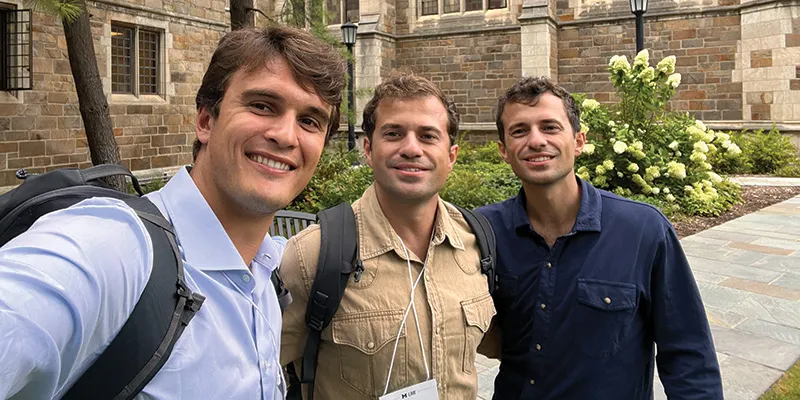
Kevin Ruf, ’87, and John Zavitsanos, ’87, have been friends since they became roommates in the Lawyers Club in the fall of 1984. Fast forward four decades, and Zavitsanos’s twin sons have connected with Ruf’s son in the Law Quad—all three enrolled at the Law School in fall 2025.
“I have always been a big fan of Michigan Law, but John takes it to another level,” Ruf says. “I remember him talking about our law school escapades while our families were on vacation together, and I think that really rubbed off on my son. He made it his mission to get into the Law School, and it is hard to imagine that they are all now in law school together—it’s surreal for all of us.”
“Despite being many time zones from one another, Kevin and Jim remain two of my closest friends. Michigan Law changed the trajectory of my life, and the relationships that started there have cemented in the years since,” says Zavitsanos. “It is heartwarming that my sons are now enrolled at Michigan Law along with Kevin’s son.”