
For Michigan Law students who are interested in becoming public defenders, MDefenders offers a robust community and a network of specialized courses and other resources to prepare them.

MDefenders grew out of “the desire to open people’s eyes to what indigent defense is really like and why it’s important, and the desire to provide community for people who want to go into this work,” says Eve Brensike Primus, ’01, founder and director of MDefenders, and the Yale Kamisar Collegiate Professor of Law.
Before creating MDefenders, Primus says that among students she had taught, “I saw a little bit of shell shock about the real practice of being a public defender.” She wanted to give them an honest look at what it’s like to work in these under-resourced and overburdened systems.
MDefenders began as a faculty-sponsored student organization in 2014 and later expanded to include an on-campus interviewing and career services arm and an alumni network. Then Primus added a curricular component and, most recently, a data partnership.
“MDefenders was a big part of the reason that I chose Michigan Law,” says 3L Jace Longenecker. “They have an excellent reputation for preparation for public defense work, and the community is one of the largest and most active at any law school in the country.”
Michigan Law students interested in public defense learn from participating in the Law School’s criminal defense clinics. And, while other law schools have criminal defense clinics, trial advocacy classes, and other programs, MDefenders’ combination of offerings is unique. “It is a level of support above and beyond that,” Primus says.
It equips students with the hard and soft skills they’ll need, and it gives them confidence and perspective, she says.
Interested Students

~10%
of current students are involved in MDefenders

Building community
In the beginning, Primus had noticed that Michigan Law had a community of students who were interested in doing public defender or criminal legal system reform work, but they weren’t very well connected to each other.
Now, the MDefenders community meets regularly for discussion and information sessions.
For Alanna Autler, ’23, staff attorney with the Neighborhood Defender Service in Detroit, MDefenders was the first place she found people who shared her feelings about the criminal legal system. Before law school, she says, “I encountered few people who shared my same beliefs about how unjust the system is and about how unfairly clients are treated. For the first time in my adult life, I was able to find that kind of community in MDefenders.”
Autler adds, “It was an accepting, welcoming community, and that can mean a lot in an environment like law school, which can sometimes be harsh and competitive.”
MDefenders includes a network of more than 450 alumni who support each other and current students in finding positions and sharing resources. The alumni directory is available to current students, so they can contact alumni directly.
Longenecker says he recently called an alum who works at an office he’s considering applying to. “They were so generous with their time to describe, honestly, the vibe of the office, their workload, their experiences there, and how they think I would like it,” he says.
MDefenders hosts regular alumni events, where alumni can hear from their peers about emerging issues, such as surveillance technologies powered by artificial intelligence, and how they might tackle them in their own jurisdictions, Autler says. “There are so many policing advancements that are affecting clients nationwide, and it’s helpful to know that we are not alone in facing these issues.”
Public Defense Network

450+
Alumni in the Michigan Law public defense network
Career resources
The interview process for public defender offices is not standard, and it can catch students off guard, Primus says. “It often involves complex ethical hypotheticals or simulated court arguments. It’s not your standard ‘walk in and talk about your resume’ interview.”
To help students through this process, Primus developed a career resources and mentorship program. First- and second-year students who want summer jobs related to indigent defense receive mentorship from 3Ls and alumni when drafting their cover letters and resumes. For 3Ls, Primus meets one on one with each student who is interested in applying for a public defender job. She talks through what type of indigent defense they are hoping to practice, reviews their resumes and cover letters, and does mock interviews.
Students have access to toolkits on what questions to ask to figure out whether an office is the right fit, and how to investigate the culture of an office, for example.

The Public Defender Training Institute taught me everything, soup to nuts, when it comes to trial work, as well as what it takes to build a meaningful rapport with clients, many of whom have every reason to distrust us right off the bat.
—Alanna Autler, ’23
Public Defender Training Institute
Now in its eighth year, the Public Defender Training Institute (PDTI) is a course for 3Ls. “It’s a yearlong immersion into the world of public defender training. It’s designed to make them zealous, client-centered advocates,” Primus says.
Students learn how to interview a client and how to argue motions, for example, and they participate in practice simulations. “Students experience what it’s like to be a public defender in a courtroom. There are going to be judges who yell at you and pressure you to give in,” Primus explains.
The course is taught by Michigan Law faculty who are current or former public defenders and aided by MDefenders alumni. Enrollment is capped at 16 students so that all students have sufficient time to participate in the simulations.
Every week, the students work in pairs, and the pairs rotate. “They work with everyone in the institute, and it becomes like a little family for that year,” Primus says.
PDTI students talk through difficult issues, such as how to represent a neo-Nazi and how to handle emotionally difficult charges like rape and child sexual abuse. Also, Primus says, “We talk about how you fight to change a racist and oppressive system when you’re a cog in the wheel of that very system.”
The curriculum also covers self-care and secondary trauma. “How do you deal with the toll that this job will take on your emotional and psychological well-being? It is hard to be in a room day in and day out as people are ripped from their communities and put into cages,” Primus says.
Autler was a student in PDTI during the 2022–2023 academic year. “It taught me everything, soup to nuts, when it comes to trial work, as well as what it takes to build a meaningful rapport with clients, many of whom have every reason to distrust us right off the bat,” she says.
For public defenders to tell their clients’ stories, gaining their trust is essential, Autler says. “When we get the case, the file is a snapshot in time. PDTI really emphasized that we’re looking at the client’s life as a whole in order to get them justice. That’s what’s going to convince judges, juries, and sometimes even prosecutors to listen to what we have to say.”
Autler returned to PDTI in 2025 to help with an exercise in arguing motions. “I had only been practicing for two years at that point, but the kinds of motions that we were practicing, that’s part of my everyday job now. So it really hit home that what they’re learning at PDTI is going to be used on a daily basis.”
Brandy Robinson, ’03, also comes back to Ann Arbor to assist with PDTI. As the head of the Federal Community Defender office in Detroit, she knows its value. “Many jurisdictions lack the time and resources to train new defenders adequately. A supervisor might drop 50 files on your desk and say, ‘Go,’ and suddenly you’re learning on the job,” she says.
“But goodness, those are people’s lives,” Robinson says. The way that PDTI equips students “with the practical skills they need to hit the ground running is priceless.”
Part of the institute is an intensive three-day retreat before classes start. Before the group spends a year together, “there needs to be a level of trust and understanding,” Primus says.
“The retreat is foundational to the entire program,” and it focuses on the fundamentals of being a public defender, Primus says. They talk about: What is a public defender? What draws you to this work? What are the difficult things about it? What are the wonderful things about it?
Blase Schmid Kearney, ’11, a clinical professor at the University of Texas at Austin School of Law and a former public defender, comes back to Michigan Law to help facilitate PDTI.
The retreat’s focus on storytelling skills, he says, “helps law students understand from the beginning that it is how people are made to feel, not logical arguments, that is driving whether or not you can be successful in this line of work as a public defender. That is a lesson that took me a while to learn.”
PDTI didn’t exist when Kearney was a law student, but he says he benefits from being part of it now. “When you get disillusioned with the institutions and the bureaucracies that you spend your time working inside of, it is rejuvenating to once a year sit with people who have so much heart and fire and so much drive to do the things that I want to do, too.”
Public Defender Training Institute

89%
of PDTI graduates continue to practice indigent defense
Data for Defenders
“There’s been an explosion in data collection and social science research in the last 20 years about how actors within the criminal legal system operate and how the system operates,” Primus says. “That research provides fodder for amazing advocacy by public defenders, but a lot of lawyers aren’t trained to look for social science research when thinking about their advocacy.” To help bridge that gap, Primus created the Data for Defenders project, a public database of resources that public defenders across the country can draw from.
“The goal is to help incorporate cutting-edge social science research and data into criminal defense pleadings,” Primus says. The project includes more than 20 public defender organizations and agency partners around the country that contribute pleadings to the database.
Michigan Law students create model pleadings as well. “I work with students to develop their written advocacy and incorporate social science into their advocacy. We find relevant social science research and transform it into defense motion templates that our partner offices around the country can use in court,” Primus says.
The motions include data about things like the science of eyewitness memory, incorporating intellectual disabilities into legal advocacy, and research about drug detection dogs.
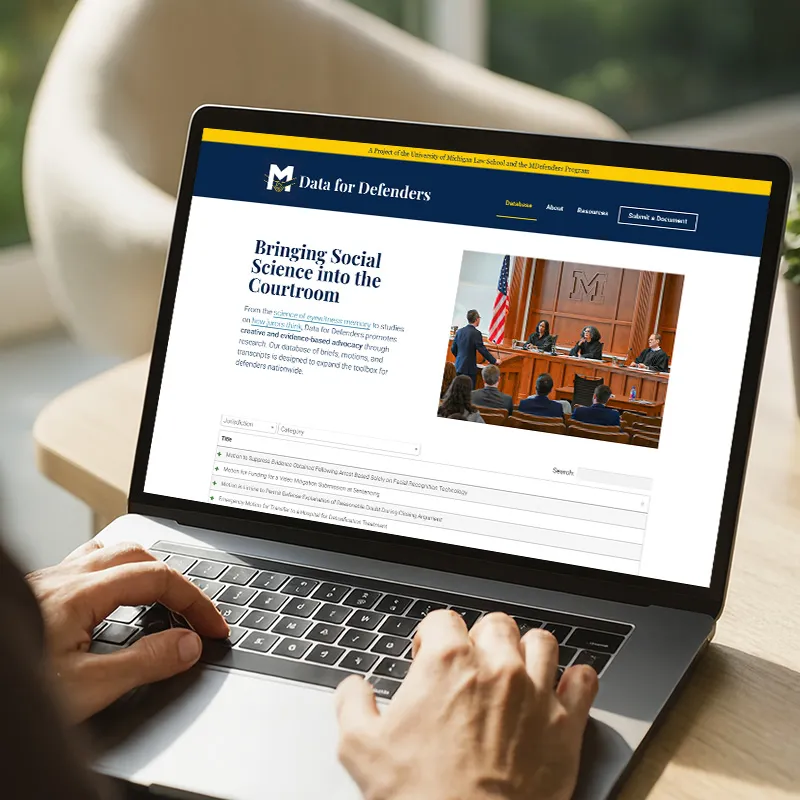
Data for Defenders is a public database of resources that public defenders across the country can draw from.
A broad reach
About 10 percent of Michigan Law students are involved in MDefenders in some way, Primus says, and 20 to 30 Michigan Law graduates go into indigent defense every year—a number that has grown annually since MDefenders was founded.
Some students, like Longenecker, choose Michigan Law because of MDefenders. Others are interested in some form of public interest work, find MDefenders, and decide to pursue indigent defense.
As MDefenders has grown over the past 12 years, PDTI’s earliest graduates are now in management positions in public defender offices, Primus says. They are incorporating lessons learned from MDefenders into their training programs for the next generation.
A newly announced grant from the University’s Strategic Initiative Fund will allow MDefenders to expand through the creation of the MDefenders Center for Public Defense. The center will serve as a national training platform for zealous, client-centered public defense advocacy; convene scholars, lawyers, and policymakers to improve and advance public defender systems; and equip other law schools to replicate the MDefenders model.
The new center will also expand curricular offerings to include more simulation-based courses like PDTI, and a partnership with U-M’s School of Social Work will prepare students to address client trauma, manage secondary trauma, and sustain long-term public service careers.
Primus says, “It’s exciting to be able to expand the training and support that we provide to students and alumni through MDefenders, while creating resources, partnerships, and programs that support defenders and strengthen public defense systems nationwide.”
Representation Everywhere
30+
states where Michigan Law alumni work in public defense