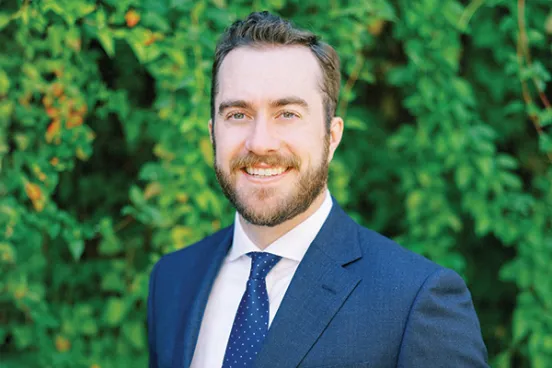
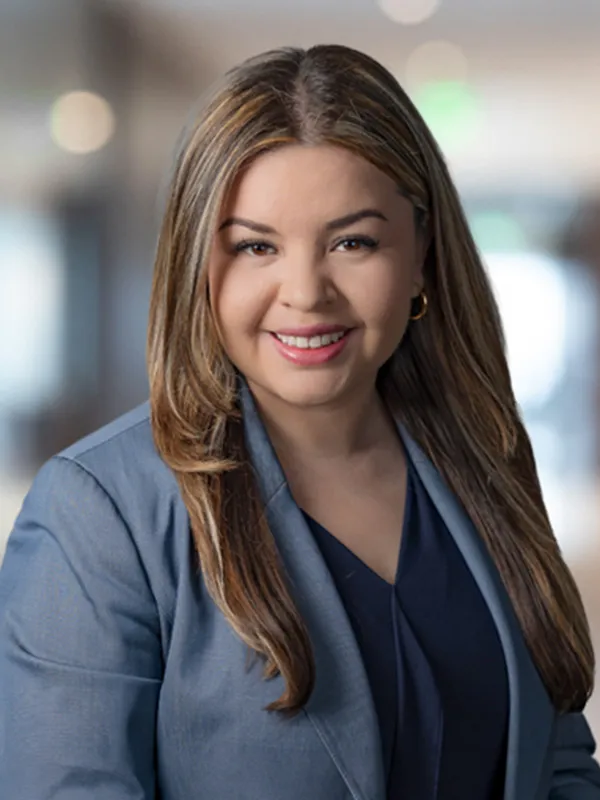
In 2023, as one of the few associates with both a Michigan and Ohio license in the Detroit office of Dykema Gossett PLLC, Elizabeth Morales, ’20, was uniquely positioned to work on a significant human trafficking case as a junior lawyer. She also had relevant experience from her time as a student-attorney in Michigan Law’s Human Trafficking and Immigration Clinic (HTC).
Following her graduation from U-M’s College of Literature, Science, and the Arts, Morales worked in Washington, DC, for the US Department of Justice’s Antitrust Division. There, she came across an article about a human trafficking raid that occurred only a few miles from her parents’ home in Southwest Detroit.
“At the time, I was still deciding between law schools, but when I saw that article and learned that Michigan Law had the Human Trafficking Clinic, among others, it was a very easy choice,” remembers Morales.
The art of translation
Communicating effectively with clients is a primary skill Morales says she learned from Michigan Law’s clinical program.
“As a law student, it’s easy to get used to talking in legalese—even more so when working at a law firm. Being able to take a story from a client, address their emotional and legal needs, and translate complex legal systems and jargon back to them is essential,” says Morales. “Law school teaches you how to understand the law, and clinics help humanize the law.”
Following graduation, Morales began working at a firm in Ohio, where she had previously been a summer associate. She returned to Michigan two years later and joined Dykema, which, around the same time, had taken on State v. Martin. Morales was the first associate assigned to the case.
The case involved Alexis Martin, a prominent antitrafficking activist and survivor from Ohio. Morales’s ability to practice across state borders, alongside her knowledge and experience in the HTC, made her the right fit. “I worked on the case with a partner who leads the white collar and government investigations group,” she says. “I spent hundreds of hours working on a pro bono basis.”
Elizabeth Morales, ’20As a law student, it’s easy to get used to talking in legalese—even more so when working at a law firm. Being able to take a story from a client, address their emotional and legal needs, and translate complex legal systems and jargon back to them is essential,” says Morales. “Law school teaches you how to understand the law, and clinics help humanize the law.
Coming to a close
At only 15, Martin was arrested for her role in the death of her alleged abuser. She was released in 2020, at the age of 22, after receiving commutation from Ohio Gov. Mike DeWine. The state placed her under parole supervision for a minimum of 14 years, which was equal to the minimum remainder of her initial sentence.
In December 2021, after a parole violation, she was returned to prison to serve the remainder of her sentence. When Martin’s case reached Dykema in 2023, the basis of its argument revolved around Ohio’s Safe Harbor Law, which is meant to direct child human trafficking victims into supportive services and, in most cases, dismiss the charges against them. The law was instituted during the time of Martin’s first arrest but was never afforded to her.
“We came in at the post-conviction stage, so we were working to get Alexis released from prison the second time,” says Morales. “We even had the help of a team of student-attorneys from the Human Trafficking Clinic, who were a huge part of the case.”
Morales left Dykema the following year and is now working in-house at the City of Detroit Water and Sewerage Department, but she continued to follow the case. In August 2025, Martin was released from prison and is spending a minimum of 18 months living, working, and receiving counseling and services through a recovery center for survivors of sex trafficking and drug addiction.
“When I was at Michigan Law, I never could’ve imagined how my work in the clinic would lay the groundwork for a life-changing case like this,” says Morales. “The same week that Alexis was released, I formally went inactive in Ohio. The timing feels serendipitous.”