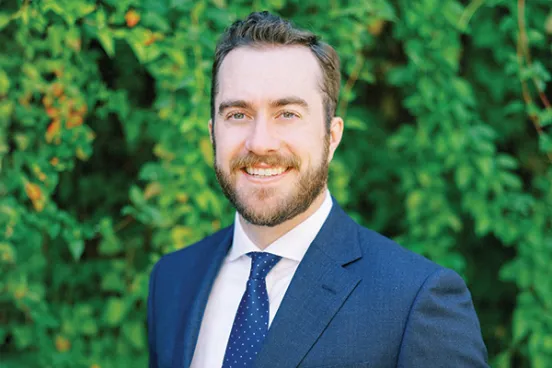
As a Colorado district court judge, the Hon. J. Chris Larson, ’99, believes it’s important to meet people where they are and to acknowledge them as they see themselves.
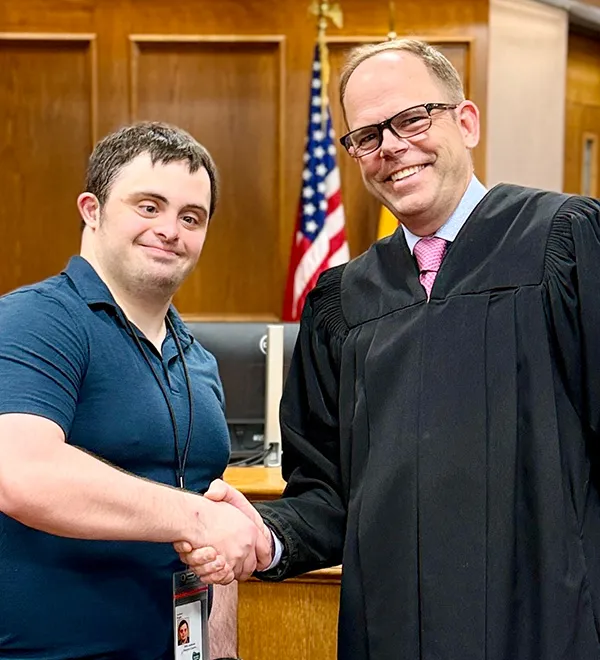
In 2024, Larson was appointed to the 20th Judicial District Court in Boulder, Colorado, after more than 20 years with the US Department of Justice. At the US Attorney’s Office in Denver, Larson created an internship program for people with intellectual disabilities, such as Down syndrome.
At the District Court, Larson launched a similar program, called the Intellectual Diversity Internship Program. “As a court, we need to serve the entire population of the county that we serve—all incomes, all educational backgrounds, and all abilities,” he says.
People with intellectual disabilities often have limited opportunities to participate fully in their communities, Larson says. Providing work opportunities opens the door to “the value and joy that realizing the full potential of an individual’s human capacity can bring to an environment.”
The interns’ contributions go beyond the tasks they complete. Having people in his chambers who process information differently helps Larson and his team communicate better with everyone who comes into the courthouse, he says.
The Hon. J. Chris Larson, ’99We’re all temporarily abled. We don’t start from a place of ability, and many of us won’t end that way, either. It’s really appreciating the fact that we’re all—every one of us—on a spectrum, and being willing and able to engage with people where they are.
Developing a supportive program
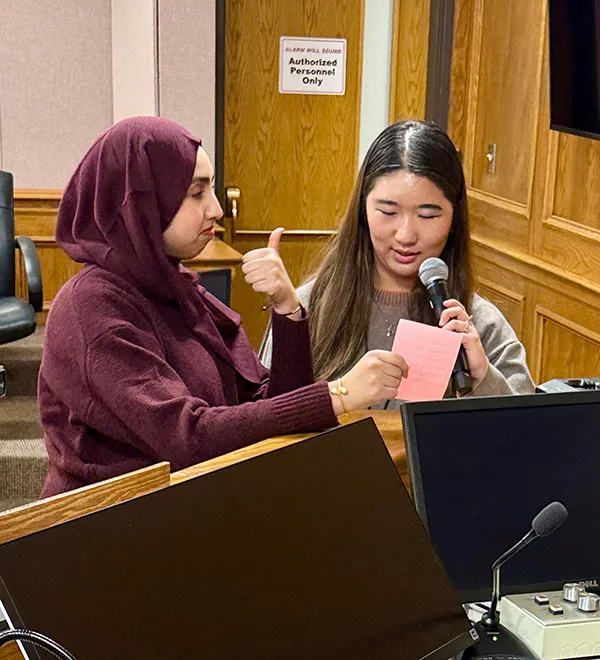
The court’s current intern, Sumin Lee, is from Regis University, which has a program for young people with intellectual disabilities. Her projects include making sure that forms are available for members of the public and that Larson’s courtroom is ready for the next day—checking all the microphones and prepping minute orders.
Lee says she likes the work and the people she works with. “After I'm done with Regis, I want to be an author that writes about criminal stuff. I want to learn more knowledge about the courthouse and how criminal justice works.”
The Regis program provides a trained peer mentor who accompanies the intern and also offers training for people who don’t have experience working with people with intellectual disabilities.
Larson credits the support of the court administration, clerk of court, Chief Judge Nancy Salomone, ’98, and other team members in getting the program off the ground.
“We’re all temporarily abled. We don’t start from a place of ability, and many of us won’t end that way, either. It’s really appreciating the fact that we’re all—every one of us—on a spectrum, and being willing and able to engage with people where they are.”
When building the program, Larson reached out to his civil procedure professor from law school, Kent Syverud, ’81, who was then the chancellor and president at Syracuse University, to learn about its InclusiveU program for people with intellectual and developmental disabilities.
Inclusion in the courtroom
“Everybody who walks into my courtroom needs to see me as their judicial officer,” Larson says. That doesn’t mean he’s biased, “but it does mean that I’m going to be able to hear whatever argument they’ve got, and they need to feel welcome in my courtroom however they are able to present.”
Larson created inclusivity guidelines that spell out how he speaks to parties and honors people’s stated names and pronouns. “It has a lot to do with removing gendered presumptions in how I meet someone for the first time,” he says. “As opposed to calling somebody Mr. or Ms., I remove that from the equation altogether, and I’ll refer to them as Counselor, Juror, or Litigant Jones.”
As Larson models this language, he’s found that most litigants do, too, even if he doesn’t draw attention to it.
“If a person knows themself a certain way, if I can reflect back that I am seeing them in the way that they know themselves, that’s the most respectful thing that I can do,” Larson says.
As a judge in a court of general jurisdiction, Larson says he learns something new every day. Being a judge is “a significant opportunity to make a positive difference in people’s lives and to help people who are stuck. They need a decision, and they need to feel heard and move on to whatever the next chapter is.”