Certainly, the work of the Law School’s clinics can leave a profound, sometimes life-altering impact on its clients. It often does the same for the student-attorneys. Law Quadrangle recently caught up with a handful of alumni whose work with the clinics was featured in the magazine during their student days. If you would like to share thoughts on your own clinical experience and your memories from your time as a student-attorney, email us at [email protected] for possible inclusion in an upcoming issue.
Child Advocacy Law Clinic
Danielle (Angeli) Asher, ’16
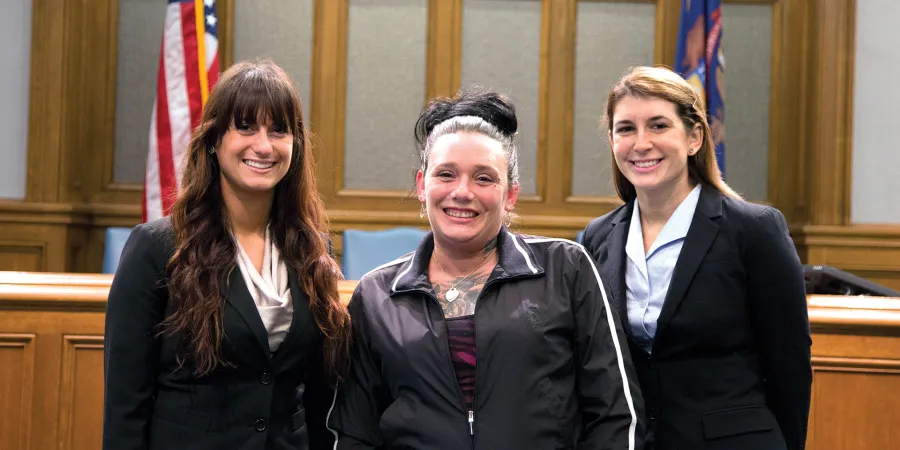
As student-attorneys, Danielle (Angeli) Asher, ’16, and her clinic partner, Alanna Farber, ’16, represented a woman named Ashley in a custody dispute. The case culminated in a bench trial, where the students successfully argued on behalf of their client. “Throughout my whole career, I will always remember her and her family,” Asher said in a spring 2016 Law Quadrangle story. “She’s the embodiment of what a survivor is.”
After graduation, Asher clerked on the US District Court for the Western District of Michigan and then joined the US Attorney’s Office for the Northern District of Ohio as an assistant US attorney in the General Crimes Unit through the Attorney General’s Honors Program. Today, she is the deputy criminal chief at the US Attorney’s Office for the Eastern District of Michigan. Before this role, she worked as an assistant US attorney in the Violent and Organized Crime Unit.
“My clinic experience reaffirmed my commitment to justice and desire to pursue a career in government service. During my time in the clinic, I felt I contributed towards achieving justice for our clients, especially for Ashley and her children. To this day, I am proud of the work that we did for her family; it was a true privilege to represent them. My experience representing a domestic violence survivor and the skills that I learned were invaluable to me as a violent crime prosecutor because I often interacted with crime victims, including victims of domestic violence.
“I have so many fond memories from working with Alanna, my clinic partner. We spent a lot of time in the clinic office preparing for Ashley’s trial. Besides the trial itself, my favorite memory was helping Ashley’s children change their last name after the judge’s ruling. It was a full-circle moment for us, and a welcome fresh start for their family.”
International Transactions Clinic
Millan Bederu, ’20
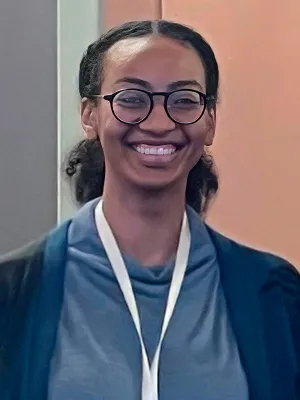
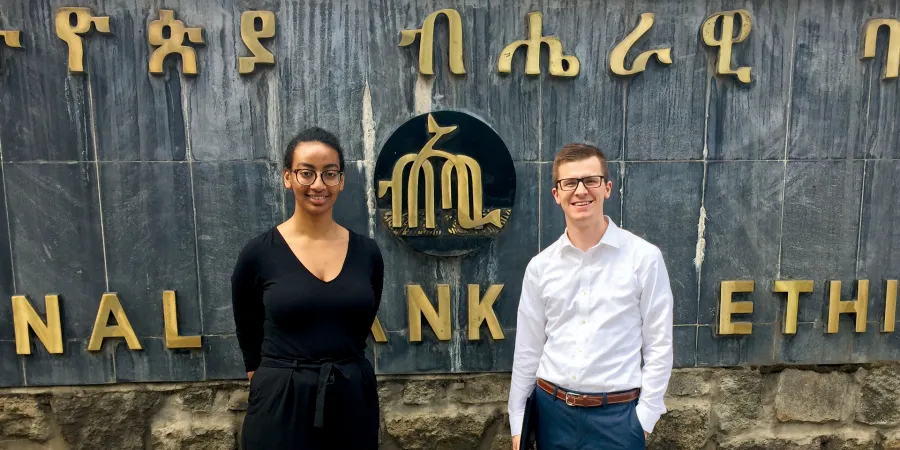
As a 2L, Millan Bederu, ’20, traveled to Ethiopia on behalf of a US-based client of Ethiopian origin who was interested in organizing a fund to invest in Ethiopian companies. Bederu—the daughter of native Ethiopians—wants to work in Ethiopia long term. “Even though I know the country, the trip gave me a different perspective,” she said in a winter 2020 Law Quadrangle story.
From 2022 to May 2025, Bederu worked for the American Bar Association’s Rule of Law Initiative on international development and human rights work funded by the US Department of State. She currently is a senior researcher and lecturer at Martin Luther University Halle- Wittenberg in Germany, pursuing research on development and human rights.
“Directly after law school, I worked in the finance practice group at a firm, and it was quite helpful that I had seen a loan agreement and a share purchase agreement and had worked with them in a low-stress environment. But while I did learn a lot in the clinic, I think the networking was most impactful. On that trip as a 2L, we were representing a private client, but I met with a lot of different government entities and saw how investment happens in Ethiopia. And through those conversations, I was able to line up an externship after my clinic. I spent the first semester of my 3L year in Ethiopia working with the Ethiopian Investment Commission. My supervisor from my externship is still a contact of mine, and Professor [David] Guenther continues to be a resource, including bringing together clinic alumni in Washington, DC, a few years ago, which was really helpful in building my network.”
General Clinic (now the Civil-Criminal Litigation Clinic)
Mary (Watkins) La Montagne, ’14
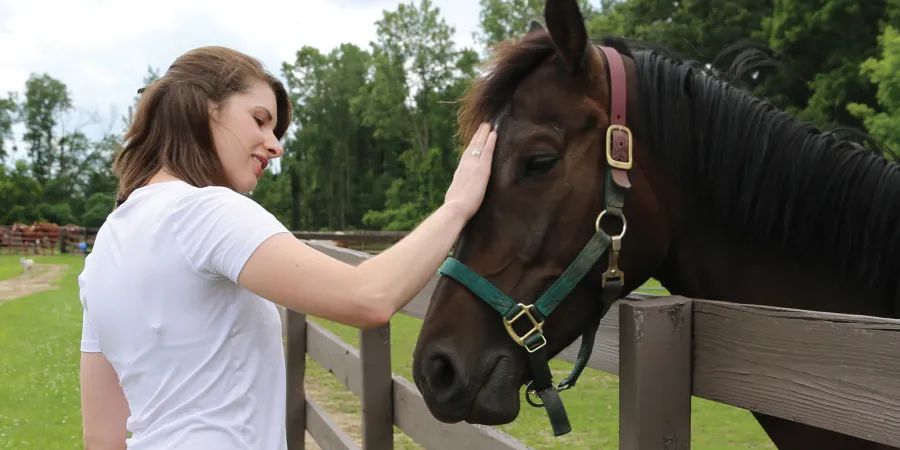
Mary (Watkins) La Montagne, ’14, blended professional experience and personal passion as a student-attorney. She was adopting her own thoroughbred, Millie, from Horses’ Haven, a nonprofit in Howell, Michigan, when she realized its contract was very out of date and left concerning gaps. La Montagne and her clinic partner, David Frisof, ’14, developed a new contract that would give the organization protective rights over animals that it adopts out. “This contract allows Horses’ Haven to…make sure that [they receive] quality care for [their] entire life,” La Montagne said in a fall 2014 Law Quadrangle story.
After graduation, La Montagne worked for the Federal Reserve Board in Washington, DC, until 2021. Among her colleagues was Jeffery Zhang, now an assistant professor at the Law School who uses Millie as a case study in his 1L Contracts class. “She appears in his hypos as the most beautiful horse in the world and thus the subject of many contract disputes,” jokes La Montagne.
Following her time at the Fed, La Montagne was a senior policy adviser in the US Department of Treasury until May 2025. Now, she is head of government affairs, US, at UBS, based in the DC area.
“Millie lived to the ripe old age of 28 (she passed last spring), having lived every last one of those days unequivocally and unapologetically on her terms. She retired from riding at 25 and then spent three years demanding special treatment from barn staff and cavorting around with her girlfriends. She was a great friend and willing athletic partner to me for the 10-plus years we were together. I’m still riding at the same barn where Millie boarded.”
Michigan Innocence Clinic
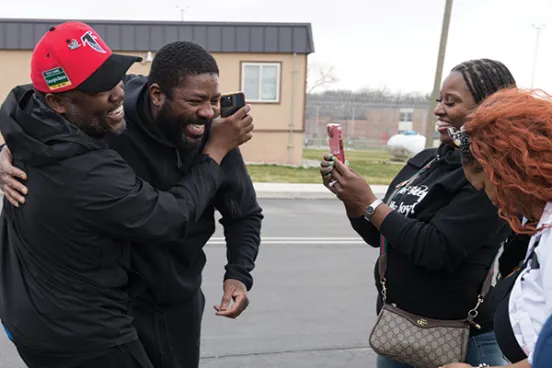
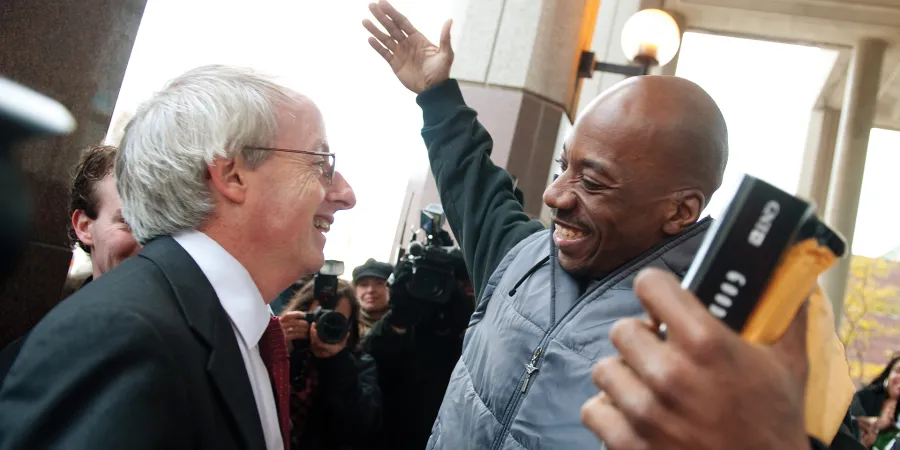
In spring 2010, Law Quadrangle’s cover story featured one of the Michigan Innocence Clinic’s first exonerations. Dwayne Provience was wrongfully convicted in 2001 for a murder on Detroit’s northwest side. His conviction was vacated and the charges were ultimately dismissed after it became clear that the police and prosecution had been aware that the murder in question was actually committed by someone else. He was exonerated nine years later. A group of student-attorneys— whom Provience called “my angels that were sent to me” in the Law Quadrangle story—worked with the clinic’s co-founding directors, David Moran, ’91, and Bridget McCormack, to free Provience. We caught up with a few of the student-attorneys.
Latoya Antonio, ’10
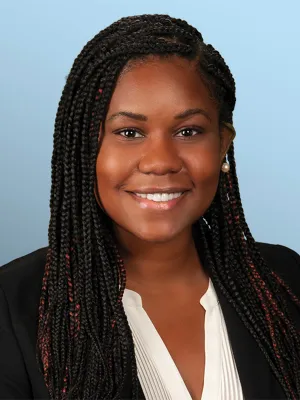
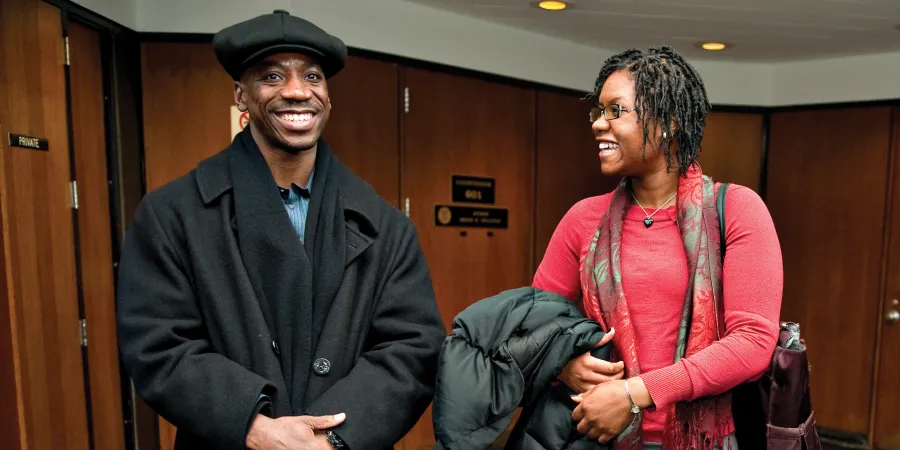
Latoya Antonio was a 3L when she was a student-attorney working on Provience’s case. By combing the streets and freeway ramps of Detroit, she and Judd Grutman, also a 3L, tracked down a key witness who could serve as an alibi for Provience. After graduation, building on her study abroad experience in Cambodia as a student, Antonio moved to South Africa and worked with social entrepreneurs. After nearly five years abroad, she returned to the United States and joined Deloitte’s human capital practice. Now, she works for Spencer Stuart, based in Atlanta, where she does executive coaching, individual assessment, and leadership development. She also is a licensed financial professional. Her career path is motivated by her desire to be a positive force in people’s lives—the same desire that led her to the Innocence Clinic.
“One thing from my time on Dwayne’s case that really hits me in the work that I do today is that your commitment— the level of dedication that you bring, your level of professionalism and efficacy—impacts people. I do assessments for succession planning for placements into different roles. And in the back of my mind, I’m thinking that the way I assess this will affect whether or not a person is going to get this job, which is going to have a greater impact on their life, on their family, on the communities that they support. If this is a diverse candidate, it opens up a whole new avenue: a space for other people to be seen and to recognize that they can then step into that role. So I constantly have this weight of the things that I do having an impact greater than myself. I hope today’s students recognize that they have power; they may be students, but they can really impact the lives of other people. So they should lean into these opportunities.”
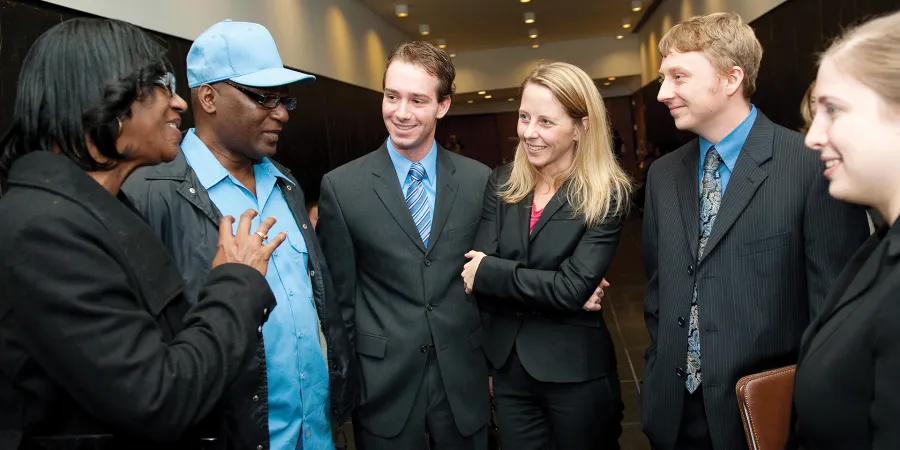
Brett DeGroff, ’10
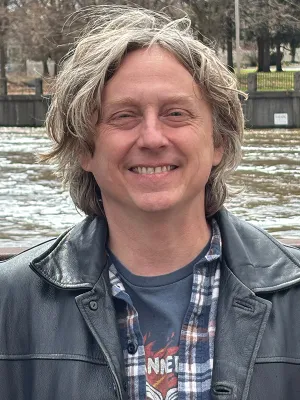
As a 3L, Brett DeGroff worked with his fellow 3Ls Nick Cheolas and Robyn Goldberg to uncover a key piece of evidence that had been buried in Provience’s file for more than seven years. He also argued motions in court on behalf of his client. Since law school, DeGroff has spent his career going between the Michigan Supreme Court and the State of Michigan Appellate Defender Office (SADO). Following a clerkship on the court, he was an assistant defender at SADO, returned to the Michigan Supreme Court as a senior law clerk, and rejoined the State Appellate Defender Office as managing attorney in 2024.
“Working on Dwayne’s case definitely changed the trajectory of my career. I’m a first-generation lawyer, so I didn’t know much about the practice of law when I started law school, and I wasn’t thinking about being a public defender. Reading cases is one thing; talking face to face with an innocent man who has been convicted of murder is another thing entirely. One thing I learned that I’ve carried with me into practice is that sometimes the truth is bizarre, but it’s always consistent. A couple pieces of false or misleading evidence can form a piece of a picture. But often they won’t fit cleanly, or they leave unexplained gaps at the edges. If you can find the gaps, you can pry apart the lies and find the truth underneath. What sticks with me more than anything from my time in the clinic, though, is the skill, patience, and commitment of Professors Moran and McCormack. I’ve worked with and litigated against a lot of good lawyers over the years since being in the clinic. Still haven’t met anyone I would say is a better lawyer.”
Maria Jhai, ’11
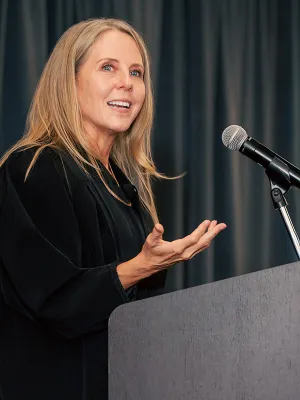
Maria Jhai worked on Provience’s case as a summer intern in 2009. She discovered prosecutors’ notes that linked a different man to the murder for which Provience was convicted. After graduation, Jhai held two federal clerkships in Detroit and then moved to Los Angeles, where she worked for Munger, Tolles & Olson LLP before joining the US Attorney’s Office for the Central District of California, National Security and Criminal Divisions. Gov. Gavin Newsom appointed her to serve as a judge in the Superior Court of Los Angeles County in 2025.
“I think the biggest effect Dwayne’s case had on me was not so much what I would do in the law but how I would do it. Mistakes and ethical lapses by several folks along the way led to Dwayne’s wrongful conviction. Through our work in the clinic, we were able to go back and correct that injustice. Meanwhile, Dwayne lost nine years of freedom. Seeing that up close prepared me to step into important roles, like judge and prosecutor, and to try to do them well and carefully. Every actor in the chain matters: prosecutor, defense attorney, judges. When you remember that, you are more likely to be careful, diligent, and fair. It was amazing to see our diligence and attention to our work translate to Dwayne’s freedom; I had never experienced anything close to that kind of responsibility and impact on someone’s life. I remember going to the prison with Dave [Moran] to tell Dwayne about the evidence that we had discovered that could help with his exoneration, and all of us waiting outside the day Dwayne was released from custody. I am forever grateful to the clinic for creating a space where I could use my education to do that kind of good.”