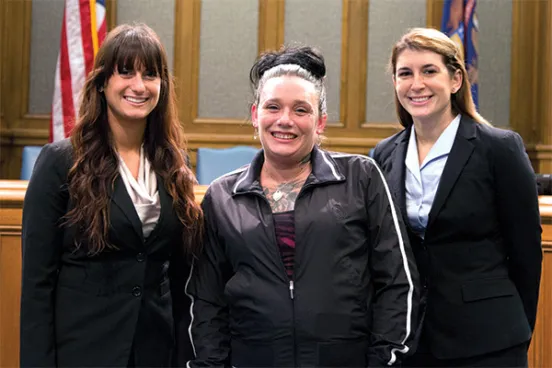
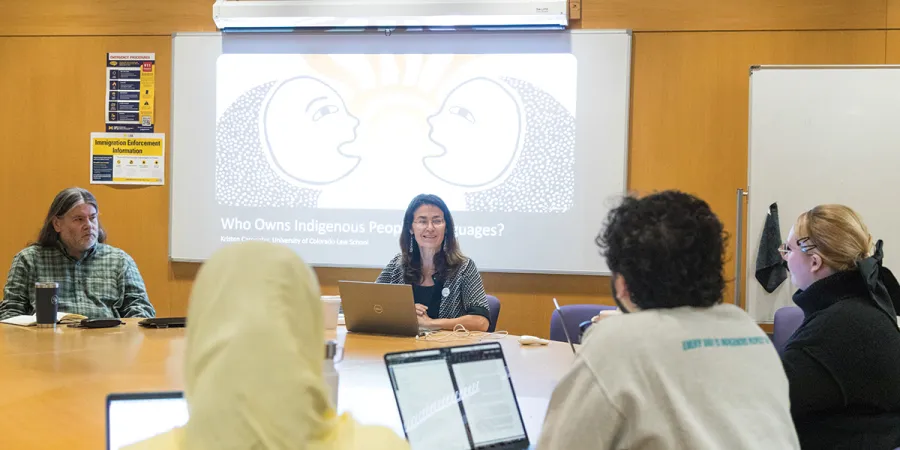
A new American Indian Law Workshop led by Matthew Fletcher, ’97, the Harry Burns Hutchins Collegiate Professor of Law, provides students with the opportunity to engage with a wide range of scholars and examine more granular, niche issues relating to American Indian law.
Offered for the first time during the winter semester, the weekly workshop is a two-credit course that explores legal trends and active cases that are at the vanguard of federal Indian law. Similar to other workshops at the Law School, such as the Law and Economics Workshop, at each session a different guest lecturer presents a working paper or scholarly project they are working on and then opens the discussion to questions. Students are required to submit written responses after each workshop.
“In a Federal Indian Law or Tribal Law class, you are mostly doing a survey of a lot of different topics in a given subject area, but that’s not usually how scholarship works—you really have to do a deep dive into, for example, a given tribe or group of tribes, and you see a lot more detail in a scholarly paper. This workshop gives us a chance to sample some of those ideas,” Fletcher says.
Bringing legal scholarship into practice
Jasmine Neosh, ’26, a tribal college graduate and member of the Menominee Indian Tribe of Wisconsin, says the workshop was valuable context as she prepares to represent tribes and tribal interests at a boutique law firm in Washington, DC, after graduation.
“The workshop forced me to think of myself and classmates as not just passive students learning complex, higher-level topics but as participants in this burgeoning world of intellectual critique,” Neosh says. “Law has not historically been very hospitable to Native Americans, and a lot of the doctrine is hostile to us individually and as a people. So it’s important, I think, to find those areas where the law is improving. And Professor Fletcher has been really great for that.”
Manuel Lewis, a rising 3L and a first-generation descendant of the Gila River Indian Community in Arizona, also says the workshop helped him see his studies in a more concrete way.
“It has recentered an observation that I came to law school with, which is that the law is actively being experienced by real people, and Indian law scholarship centers that in a way that not all scholarship does,” says Lewis, who intends to do litigation on behalf of tribal clients after law school. “Indian law is a weird space because it’s bifurcated between federal Indian law and tribal law, and then tribes are also sovereign governments, which creates interesting, dynamic legal structures. It’s been extremely rewarding to talk to scholars who are pushing the boundaries of what the doctrine means, and to be able to rethink or do something new with the law rather than learn it as a doctrine as it exists in its static nature.”
Fletcher says the workshop is indicative of the growth in legal work and advocacy related to Indian and tribal law—as evidenced by the areas of legal inquiry covered in the workshop series.
“Tribal nations are doing a lot more—they have more, they're growing, they have more capacity. In our field, we refer to this era as the self-determination era, as opposed to the assimilation era where Native kids had to go to boarding school and all the land was taken over by the federal government,” he says. “We are bringing in legal scholars as well as practitioners, which helps students see how legal scholarship matters in the real world, and how practicing lawyers can employ legal scholarship in the work that they do.”
Jasmine Neosh, ’26The workshop forced me to think of myself and classmates as not just passive students learning complex, higher level topics but as participants in this burgeoning world of intellectual critique.
Workshop Speakers Touch on Tribal History, Property Rights
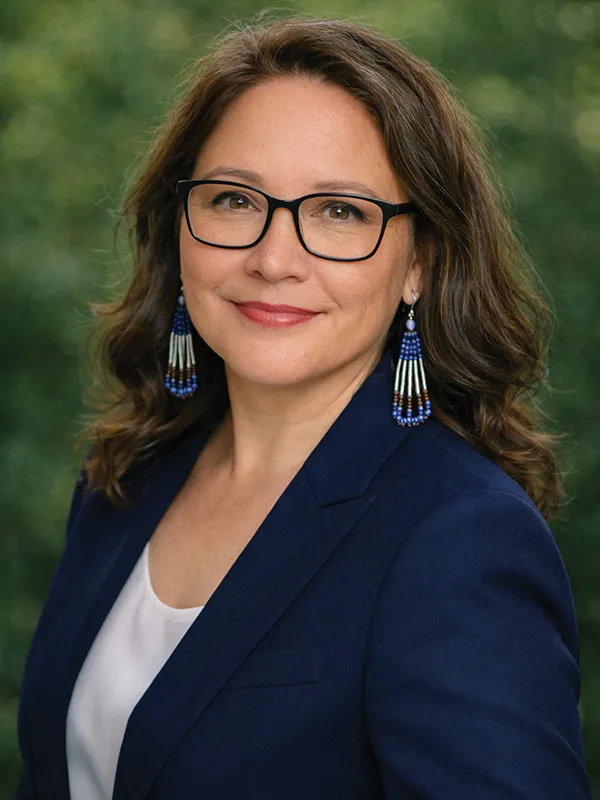
Wenona T. Singel, an associate professor of law at Michigan State University College of Law and the director of the school’s Indigenous Law & Policy Center, visited the workshop and spoke about the first chapter of her upcoming book, The Land Still Holds the Record: Native Life, Law, and Erasure in Michigan.
Singel is a member of the Little Traverse Bay Bands of Odawa Indians who has served as chief appellate judge for two tribal courts in Michigan. As a descendant of Native Michiganders, Singel uses her family’s history to explore how federal Indian law has caused intergenerational harm across Native communities in Michigan.
“I started this project because I was searching for my own family history, and my most immediate experience of that kind of trauma was losing my younger sister to adoption when I was four years old,” she said. “In addition to that, my mother and all her siblings were removed from their parents and placed into foster care and adoption.”
The project reconstructs a more complete history of Native removal in Michigan, drawing on archival records that document removal in detail while simultaneously structuring the erasure of its human consequences. Singel said that the records of major events in the history of Michigan’s Indigenous peoples, such as the forced removal of Native communities in the 19th century, elide much of the harm they caused.
“What you see in the archive is the muster roll—a list with the heads of households identified, but children and women are hash marks. These archives are not a reliable source for understanding what happened to those children, what happened to those women, or what happened to people that didn't make it onto those lists,” she said. “It tells us about the priority of how the federal government viewed Native people, but the omissions are not incidental—they reveal how the federal government structured its priorities and whose lives it deemed legible.
“We oftentimes think of the law as having an episodic, individual impact in time, in terms of removal or in terms of mandating a child attend boarding school. But what remains largely unacknowledged are the intergenerational consequences for Native families.”

Bryan Newland, a former assistant secretary of Indian affairs at the US Department of the Interior who now works at Powers, Pyles, Sutter, and Verville PC in Washington, DC, joined the workshop to present a working paper titled “Trespass? Don’t Mind If You Do: The recent trend of courts using equity to excuse trespassing on Indian lands.”
“To understand some of the cases in this paper, you have to understand the founding principles of Indian law, and those principles were in service of taking things that didn’t belong to people,” he said. “In order to justify taking land that belongs to others, you have to come up with principles that diminish their property rights against your property rights.”
The concept of the discovery doctrine, which is rooted in 15th century papal decrees that claimed European colonialists had the right to take possession of land from Indigenous peoples in the Americas and surrounding islands, was enshrined into American law in an 1823 Supreme Court ruling, Johnson v. McIntosh. It held that established international law gave European nations the right to seize and settle on land in the so-called new world, and that the United States government had inherited that right after the Revolutionary War.
The paper examines a number of recent cases in which federal circuit courts have used equitable exceptions to rule against the property rights of Indian landowners. Newland writes that the rulings represent “a concerning trend of judges applying equitable rules to override federal statutes and diminish Indian property rights.”
The paper also proposes actions that tribes and individuals can take to strengthen Indian property rights, as well as suggested Congressional action.
“The lack of a trespass statute for Indian law has caused a lot of damage,” he said. “So one of the things that we need is a congressional enactment giving Indian tribes and Indian people a federal cause of action to seek enforcement of their property rights in federal court.”