Ruben Piñuelas, ’26, knows firsthand how the legal system can wrongfully convict someone—and how that same system can sometimes right the wrong.
As a young man in California, he fought and eventually overturned his own false conviction for conspiracy to commit murder. And earlier this year, he played a key role in exonerating someone else from an unjust murder charge.
Inside the legal system
Young Ruben was a bright, engaged student. But he lived in a small, rural California town, where constructive opportunities for young people were limited. He became involved with gangs and drugs and accumulated a police record.
At 19, he tried to make a new start by working a warehouse job in Los Angeles. Yet police found him with recreational marijuana and wrongly accused him of drug dealing, a charge that resulted in a two-year prison sentence. A prison riot, during which he only defended himself, resulted in an assault charge and extended his sentence by seven years. Two days before he was due to be paroled, he received the most crushing blow: a new charge of conspiracy to commit murder.
The prosecution advanced a theory of conspiracy between two other inmates, but Piñuelas didn’t even know them. Yet prosecutors succeeded in painting him as the ringleader, despite a lack of evidence.
The new charge set off a long ordeal involving attempts to plant evidence, more trumped-up charges, and offerings of plea deals. “I told my attorney at the time, ‘You tell the DA I'm not taking a single day. I didn't do this,’” Piñuelas says now.
In hindsight, Piñuelas believes the charge was payback for his efforts to help other inmates with appeals—his first experience acting as a lawyer of sorts.
Piñuelas was sentenced to 60 years to life. In solitary confinement, he started studying the law in earnest, filing an appeal of his conviction along with numerous habeas corpus petitions.
Eventually, the letter he was waiting for arrived: His conviction was overturned for lack of evidence, and there would not be a retrial. He would soon be a free man.
Ruben Piñuelas, ’26I realized, ‘I’ve got to give the pain purpose.’
Finally, a fresh start
Piñuelas worked in construction for a couple of years while trying to rebuild his life—and his psyche. Therapy didn’t help, nor did going to college to study psychology.
Eventually, he found some common ground listening to the experiences of Holocaust survivors on TV. When he met one survivor in person, she gave him life-changing advice: “It’s not what was done to you. It’s what you choose to do with it.”
Piñuelas recalls, “I felt this huge weight lift off my shoulders. I realized, ‘I’ve got to give the pain purpose.’”
All along, friends and family had been telling Piñuelas he should go to law school. When he spoke at an award ceremony at his college, a professor mentioned an internship at the Loyola Project for the Innocent. A judicial internship followed. He eventually came to see law school as a way to reclaim control of his future.
Michigan Law appealed to him because of the Michigan Innocence Clinic (MIC), the MDefenders program, and professors who are active in criminal justice reform. He also liked the people and the collaborative atmosphere. “Everyone's trying to get each other across that finish line,” he says.
Piñuelas was initially interested in Big Law, but working with public interest groups at Michigan made his ultimate direction clear.
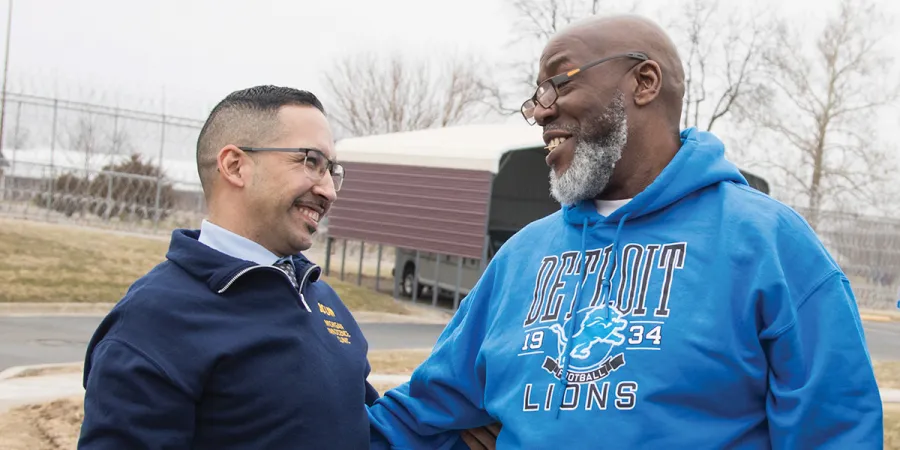
That work culminated with the MIC-led exoneration in March 2026 of George Calicut, a Detroit man who served 27 years in prison for a murder he did not commit. Piñuelas worked on the case and spoke in court at the release. In the immediate aftermath, he says, “for half a moment, the pain stopped. I felt at peace.”
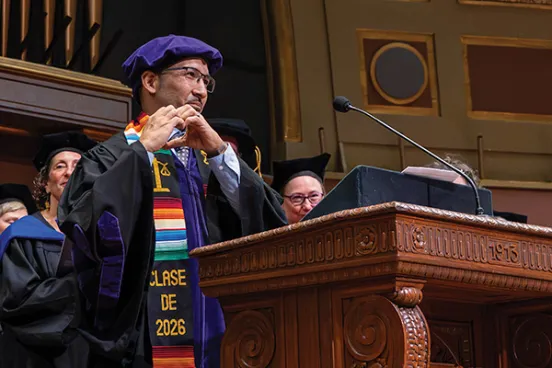
Piñuelas, who was chosen by his classmates to deliver the student address for Senior Day in May 2026, is returning to California after graduation to advocate for the same communities he comes from at the Los Angeles Public Defender’s Office. He also plans to continue working to prevent wrongful convictions, including serving on a commission addressing prosecutorial misconduct. “I will try to make things right,” he says. “To bring as much justice to that state as I can.”