
When Sean Grimsley, ’00, and Eric Olson, ’00, started their impact litigation firm in September 2023, they had the loftiest of goals: to chart a path that would allow them to make a difference in the world. Two years after founding Denver-based Olson Grimsley, they are realizing that goal by taking on several cases that support the public interest through plaintiff-side litigation.
One case resulted in a $60 million verdict on behalf of a client whose 25-day-old child died after consuming a cow’s milk-based formula that caused a fatal intestinal disease. In another, they obtained a judgment of more than $20 million following an antitrust trial representing a small, upstart industrial insulation manufacturer against the dominant incumbent.
Their current work includes two cases related to human trafficking, four more infant formula cases, and another that is seeking compensation for college athletes who opted out of a large class action settlement. In total, the firm has tried seven cases, argued four appeals, and won more than $80 million in judgments in just two years.
“The firm was a way for us to do work that we valued,” says Olson. “And starting the firm with a friend makes it a lot easier because of the trust we have in each other.”
Starting the firm
Grimsley and Olson met during a Habitat for Humanity-type service day project during Law School orientation.
“We didn't construct very much that day,” says Grimsley, who remembers noticing Olson as he squeezed his lanky frame into a Bobcat. “But I don’t think we deconstructed anything.”
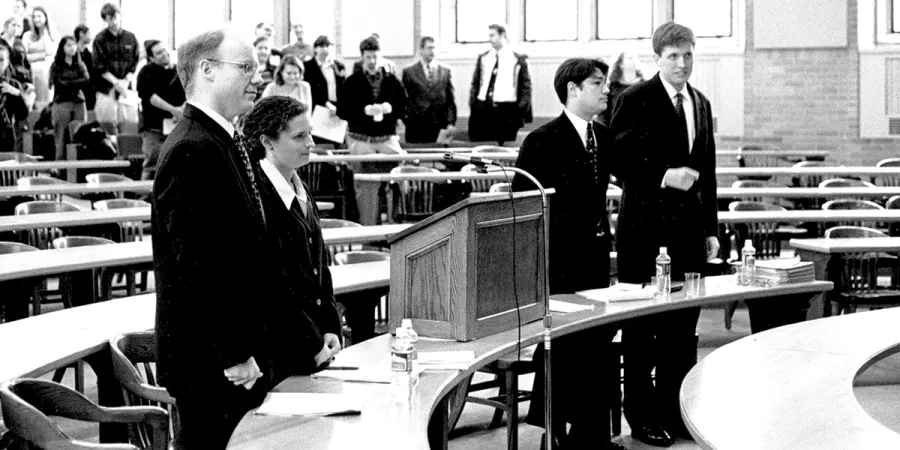
Once classes started, they ended up in the same section and study group and later teamed up for the 2000 Campbell Moot Court Competition, coming in second to their friends Abigail Carter, ’00, and Bill Jenks, ’00. What was it like losing to friends?
“It would be better if it weren’t people we heard from all the time,” Grimsley jokes. “Bill definitely never misses an opportunity to remind us.”
Following graduation, Olson’s and Grimsley’s paths ran on similar tracks. Both had summer jobs at Covington & Burling in Washington, DC, after which Grimsley clerked for the Hon. Harry T. Edwards, ’65, on the US Court of Appeals for the District of Columbia Circuit and Olson for the Hon. John G. Heyburn on the US District Court for the Western District of Kentucky, his home state. Olson later clerked for Judge Edwards, and both clerked a year apart on the US Supreme Court (Grimsley for Justice O’Connor and Olson for Justice Stevens).
Their paths converged in 2004, when Grimsley joined Bartlit Beck LLP in Denver, where Olson had worked for about a year, first in the Chicago office, then in Denver. In 2019, Olson left to work as solicitor general in the Colorado attorney general’s office; Grimsley left two years later to work as general counsel for Ibotta Inc., a digital promotions network that a former colleague had started.
Both were fulfilled in their careers, but they felt the tug of the civil litigation work that each had done at Bartlit Beck. Their professional stars aligned at the same time, and with their shared interest in pursuing plaintiff-side public interest work, Olson Grimsley was born.
Roughly speaking, the firm—comprising 10 lawyers and five other professionals—does about one-third public interest work, generally pro bono or at “low bono” rates (heavily discounted for those who can’t pay full freight). The remaining two-thirds of the work is split between plaintiff-side contingency work and more typical lawyer-client payment terms.
“The flexibility of being able to choose what cases we take is very meaningful,” says Olson. “We say no to a lot of cases that come across our door because life’s too short to work on things that we don’t enjoy.”
Saying yes to cases
Among the cases they have said yes to are two human trafficking suits, representing about 100 Filipino workers who helped build stadiums in Qatar for the 2022 FIFA World Cup. Construction for the event was massive, including a new airport, railroads, and hotels. While generating billions of dollars in revenue, the event relied on thousands of workers who were subjected to inhumane conditions.
In partnership with Sparacino PLLC, Olson Grimsley filed a complaint that states that four firms violated the Trafficking Victims Protection Reauthorization Act and outlines the treatment and conditions that the workers were subjected to, including long hours, physical injuries, and mental trauma. Earlier this year, the defendants moved to dismiss the case, but the plaintiffs won that decision.
Eric Olson, ’00We say no to a lot of cases that come across our door because life’s too short to work on things that we don’t enjoy.
“It is a really novel and interesting case about enforcing what is pretty basic US law, which says that if you’re part of a venture that benefits from human trafficking, you’re responsible for it,” says Olson. “The organization that supervised the construction was a Colorado-based company that was acquired by a larger national company during the construction. So it’s a combination of hard legal issues, interesting factual development, and advocacy that makes a real difference.”
Another Olson Grimsley case involves more than 300 student-athletes who have opted out of House v. NCAA, a $2.8 billion settlement between the NCAA and the Power Five athletic conferences in a federal class action antitrust lawsuit. The settlement allows revenue sharing between Division I colleges and student-athletes who competed from 2016 to 2024.
The firm is representing about 75 percent of the student-atheletes who opted out of that settlement because it undervalued how much they could have made off their name, image, and likeness as well as their share of revenue generated by college sports, if not for rules imposed by the NCAA. Olson Grimsley aims to recover the full amount these athletes would have made.
In addition to developing their own cases, Olson Grimsley also joins cases brought by other firms.
“One of the things we like to do as a firm, since we’re small, is team up with other plaintiffs firms who have worked up a case but need trial lawyers to come in and try the case. We want to be the go-to firm that others call to come in and help out,” says Grimsley.
That happened in the $60 million verdict against Mead Johnson Nutrition, the manufacturer of Enfamil Premature Formula. Olson Grimsley worked with Keller Postman, a Chicago firm that had developed the case but, only a month before the trial, needed lawyers to argue in court. By coincidence, the firm representing Mead Johnson was Covington & Burling, the firm where Grimsley and Olson interned after law school.
“It’s an example of us bringing our unique skills and experience to bear in a way that makes a positive difference in the world,” says Grimsley, who took the lead on the case.
“There are not many lawyers in the country who can drop into a complicated case against one of the best law firms in the country on the other side and have that kind of success,” says Olson. “It’s a great example of us coming in and working on a challenging case and getting a great outcome.”