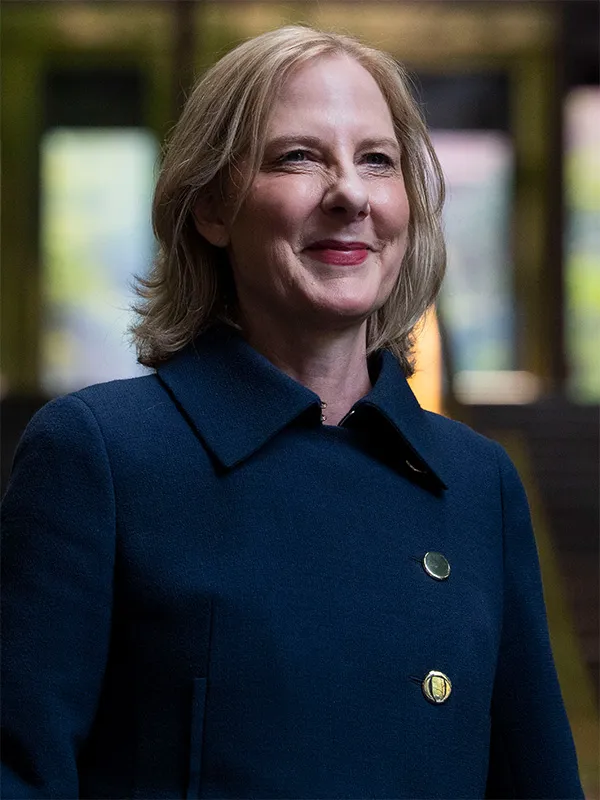
Democracy is unfinished work, says Heather Gerken, ’94, who became the Ford Foundation’s eleventh president in November 2025. Sometimes people take democracy for granted, as an established system, but it requires people to protect it.
In the United States and around the world, “some of the basic building blocks of democracies are being eroded and attacked,” Gerken says. In April, she announced that the Ford Foundation is investing an additional $60 million in new grants to defend the rule of law, fortify voting rights, and boost civic participation.
No matter what issues people care about, “Everything depends on the rule of law being upheld and on having free and fair elections,” Gerken says.
Gerken took the helm at the Ford Foundation after serving as Yale Law School’s dean for eight years. Throughout her career, she has pushed to protect and strengthen democracy and the rule of law—and to prepare lawyers to do this work.
Gerken’s interest in voting rights goes back to her days at Michigan Law, where she took the Law School’s first election law course. The professor was Richard Pildes, who became Gerken’s mentor. “He was one of the founders of the field, and that course changed my life forever,” she says. In the ’90s, her first work as a lawyer was handling voting rights cases.
In 2012, Gerken published The Democracy Index (Princeton University Press), which proposed a system that would rate the performance of state and local election procedures. In 2013, the Pew Charitable Trusts adopted her proposal into the nation’s first Election Performance Index, and election administrators used it to revamp their systems.
“Election administrators are under enormous pressure in this polarized moment,” Gerken says. “The pressure to change a rule, bend a rule, find votes—those are things that should never be asked of election administrators. We should just allow them to count the votes.”
Gerken adds, “Election administrators are our neighbors. These are the everyday people who make our democracy possible.”
The Ford Foundation’s new grants support nonpartisan and bipartisan nonprofits and veterans organizations such as Campaign Legal Center, Veterans for All Voters, and Pillars of the Community.
Strengthening democratic values is built into the Ford Foundation’s mission, Gerken says. It has a history of supporting social justice and civil rights, and “it built the backbone of public interest law. It’s the reason legal clinics exist, because it seeded them across the United States,” she adds.
Heather Gerken, ’94Lawyers understand that there are these bedrock principles about which there is no debate, even among the group that can debate anything. Those are the things that are left standing after the most argumentative people on the planet spent a century arguing about them.
An obligation for lawyers and law schools
Although the rule of law is under attack, lawyers agree on the rule of law and basic democratic norms, Gerken says. “Lawyers understand that there are these bedrock principles about which there is no debate, even among the group that can debate anything,” she says. “Those are the things that are left standing after the most argumentative people on the planet spent a century arguing about them.”
Lawyers and law schools are well positioned to do democracy’s unfinished work. Gerken is a former member of the American Bar Association Task Force for American Democracy, a bipartisan group of experts in law, public administration, and politics that works to improve public trust in the election system and support the rule of law.
In 2024, the task force published a letter highlighting law schools’ role in supporting constitutional democracy. “I’m really proud to say that I was part of a small group of deans who helped organize a statement by almost all the deans across the United States in the wake of January 6th to talk about the importance of the rule of law,” she says.
As law schools prepare people to serve as lawyers, legal clinics are essential, Gerken says. “I do not think that anyone should graduate from a law school without having used the skills that they’ve been given.”
Clinics teach students to serve real people with real problems in real time, she says. “That is the moral obligation you have when you are lucky enough to be able to go to law school.”
Heather Gerken, ’94When we started bringing in students who came from below the poverty line, it quickly became clear that they don’t experience debt as an individual matter. They experience it as a family matter. . . . These students don’t have a safety net. They are the safety net for their own families.
Kicking open the doors
Gerken became the first female dean of Yale Law School in 2017. During her eight years as dean, she says, “The way I saw it, my job was to kick open the doors of legal education.”
Under Gerken’s leadership, Yale Law School—which had always based financial aid entirely on need—significantly boosted the amount of need-based financial aid it offered, including launching its first full-tuition scholarships for students from low-income households. “We went from a fairly small percentage of students who came from just below or above the poverty line to 15 percent of the class, and it continues to increase,” she says.
“When we started bringing in students who came from below the poverty line, it quickly became clear that they don’t experience debt as an individual matter. They experience it as a family matter, and they were never going to put another dollar of debt on their family’s shoulders,” Gerken says. “These students don’t have a safety net. They are the safety net for their own families.”
Yale also admitted more students who were the first in their families to attend college, and it increased the number of veterans from 1 percent to 10 percent.
Gerken sees access to law school as an issue of fairness and justice. “Lawyers are at the table for so many important things, and if you don’t have different types of people represented at the table, you’re making a mistake,” she says.
Since U.S. News & World Report first established its law school rankings, Yale had been listed as the number-one school every year. But those rankings discouraged law schools from providing need-based aid by incentivizing them to give it to students with the highest academic scores instead, Gerken explains.
“The U.S. News & World Report rankings are the reason why so many deans took money away from the need-based scholarship bucket and put it into what they call merit-based,” she says. “They were just competing for numbers.”
In 2022, Gerken pulled Yale Law School out of the rankings. It was the first, but more than 60 schools followed, including Michigan. “One dean after another read that we had dropped out and did the same immediately, because they all knew how pernicious the U.S. News rankings were,” she says.
At the time, statistics showed that roughly 85 percent of students who received financial aid didn’t have to show any financial need, Gerken says. “That is not a way to open up the legal system. So we did everything we could to change that.”
The rankings also discouraged law schools from supporting public interest careers, Gerken says.
“This is the magic of being a dean of a law school: You’re basically training the next generation of lawyers and leaders,” she says. “You have to think not just about the basic knowledge that they need to have but the deep ethical principles that they need to have.”
Gerken’s commitment to democracy and the rule of law runs deep. “I’ve worked all of my life on these issues—on thinking about how a democracy should work and on protecting voting rights,” as a lawyer, professor, and dean, she says. “All of that work informed the work that I’m doing at the Ford Foundation, and it really does date back to the extraordinary education I got at Michigan.”