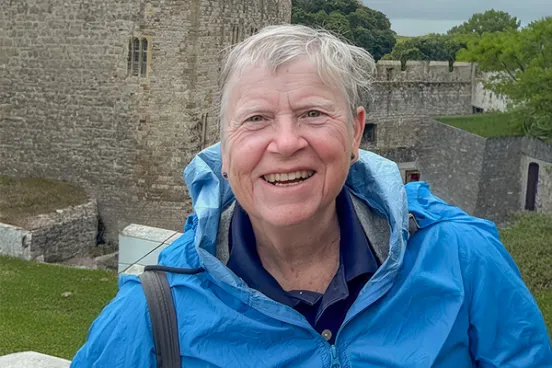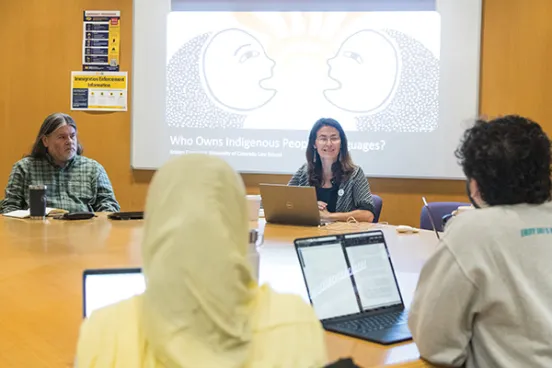
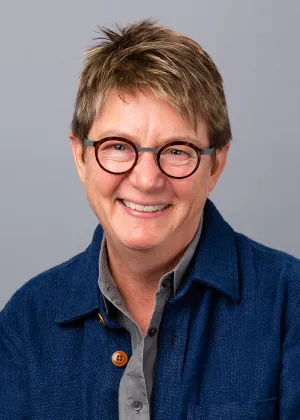
Martha Umphrey, ’91, thrived as a professor in Amherst College’s Department of Law, Jurisprudence, and Social Thought for 30 years, teaching undergraduate students the concepts of law through an interdisciplinary lens.
While her own educational experience occurred at a large research university—in addition to her JD, she earned her bachelor’s and PhD at the University of Michigan—she enjoyed the “high touch” environment of a small college.
“The beauty of a small college is that student-faculty connection is really at the heart of the educational enterprise,” Umphrey says of Amherst, consistently ranked as one of the best private liberal arts colleges in the country. “We are constantly interacting with these young people, watching them develop, helping them work through the inevitable bumps in the road.”
While she could have remained in that position for the rest of her career, things changed two years ago when the position of provost and dean of faculty opened up. Colleagues nominated her to fill it—a vote of confidence in her ability to transition from a teaching to an administrative role.
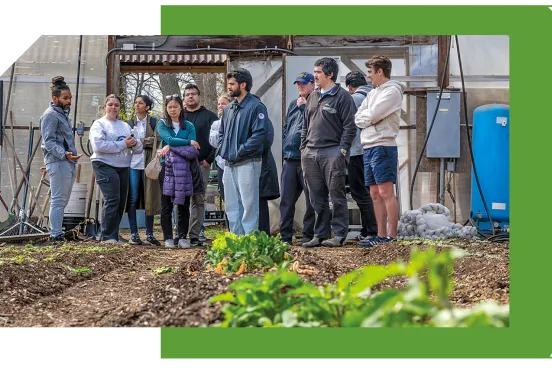
Since July 2024, she has served as President Michael Elliott’s number two, overseeing everything from academics and libraries to athletics and the Emily Dickinson Museum. She is responsible for creating an educational environment that supports more than 300 faculty and 1,850 students while administering budgetary and personnel issues. Her work on committees over the years positioned her to take on a broader role.
“It's really not a matter of learning something brand new as much as it is stretching vertically,” she says, “both down into the weeds and up to the biggest picture of things going on in higher education.”
Confronting challenges
As Umphrey tackles her new role, her Michigan Law degree has often worked to her advantage.
“Being able to parse different kinds of legal concepts has turned out to be really valuable,” she says. “For example, we got a memo a couple of months ago from the Department of Justice that discussed the ways in which the DOJ was going to use the False Claims Act to try to enforce its understanding of civil rights law. We needed to explain to our scientists what the False Claims Act is to help them understand the intricacies around certifying their grant applications for federal funds. I spent quite a bit of time translating complicated legal concepts.”
And like administrators at colleges and universities across the country, she is confronting a host of challenges unique to our times.
Martha Umphrey, ’91We’re trying to think forward as far as we can into the future to anticipate what might be coming next.
For example, Umphrey points to the uncharted frontier of artificial intelligence (AI) and the risks and rewards it holds for higher ed. She has constituted a collegewide AI working group to address the effects of AI not just on pedagogy and academic integrity issues but also on research, administrative systems, and other areas.
“This is such a fast-moving and really fascinating environment,” she says. “We’re doing a search for a new director of our career center, and AI is very much on my mind as we think about the kinds of people that we’re looking to interview.”
Amherst is also adjusting to changes in federal funding for science and the arts.
“It has certainly affected Amherst College,” she says. ”We have some very successful scientists here who rely on federal grants. So we’ve been working with them to secure funding. The same is true with the arts. An arts grant at a small college goes a long way.”
She adds that issues around admissions, academic freedom, and a proposed endowment tax that emerged in the congressional budget reconciliation process are also at the forefront of her thinking.
“We’re trying to think forward as far as we can into the future to anticipate what might be coming next,” she says. “And we’re working with peer colleges to tell a story about what small colleges do.”