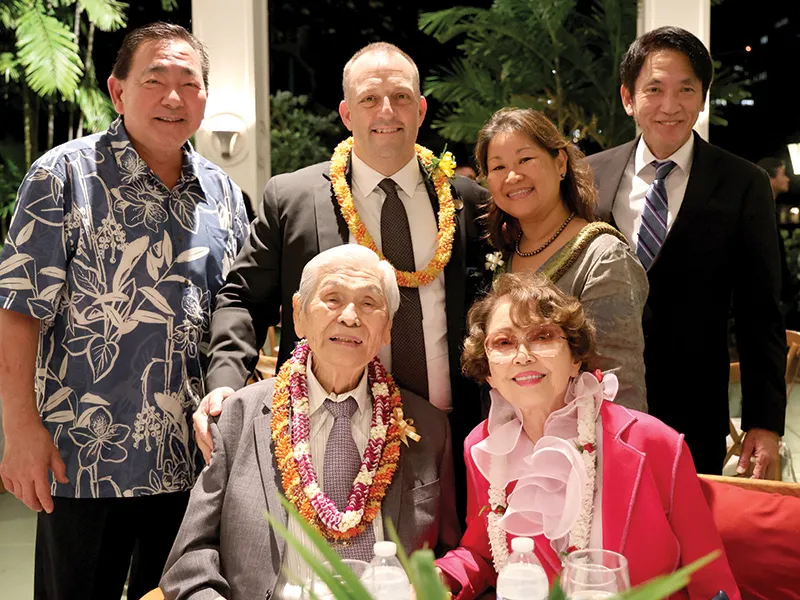
George R. Ariyoshi, ’52, the nation’s first Asian American state governor, died on April 19, 2026. He was 100.
Ariyoshi rose from a tenement in Honolulu, where he was born in 1926 to Japanese immigrants, to become a powerful force in Hawaiian politics and the state’s longest-serving governor.
“Governor Ariyoshi devoted his life to Hawaii with humility, discipline, and an unwavering sense of responsibility to the people he served,” said Hawaii’s current governor, Josh Green, in a statement. “He led our state during a pivotal moment with quiet strength and integrity, and his legacy as a trailblazer and public servant will endure for generations.”
Ariyoshi was first elected to political office in 1954 when he became a member of the territorial house of representatives. After Hawaii achieved statehood in 1959, Ariyoshi served in the state senate and as its majority leader. He was elected lieutenant governor in 1970 and became acting governor in 1973 when Gov. John Burns was incapacitated with terminal cancer.
He successfully ran for governor in 1974 and was reelected in 1978 and 1982. He led Hawaii through a tourism and population boom that strained the state’s housing and infrastructure, as well as a recession in the mid-1970s. He was known for promoting tourism while attempting to slow an influx of people moving from other states; he also was known for his efforts to diversify the local economy to become less reliant on tourism alone.
In 1986, Ariyoshi retired from politics—having never lost an election—and returned to the practice of law. He served as director of numerous corporations and nonprofits, was president of the Pacific Basin Development Council and was chairman of the East-West Center. He also was named to an advisory committee for trade policy by President Clinton. In 1997, he published an autobiography, With Obligation to All (University of Hawaii Press).
Ariyoshi graduated from high school in 1944 and joined the US Army Military Intelligence Service during World War II as a Japanese-English interpreter. After the war, he enrolled at the University of Hawaii and transferred to Michigan State University, where he earned a degree in history and political science. He graduated from Michigan Law in 1952 and returned to Honolulu to enter private practice.
As he later recalled in a 2012 interview with PBS, it was around this time that Ariyoshi discovered that his father, a seaman, had illegally entered the United States by jumping ship in Honolulu. He had never tried to become a US citizen for fear of being caught. But Congress overhauled the country’s immigration laws in 1952, and Ariyoshi’s first project as a lawyer was to prove that his father had been continuously in the country for decades and was entitled to long-term permanent residency. He succeeded.
Ariyoshi is survived by his wife, Jean; their three children, Lynn, Ryozo, and Donn; four grandchildren; and three great-grandchildren.
This obituary draws on articles published in the New York Times on April 20, 2026, and in the Guardian on April 21, 2026.