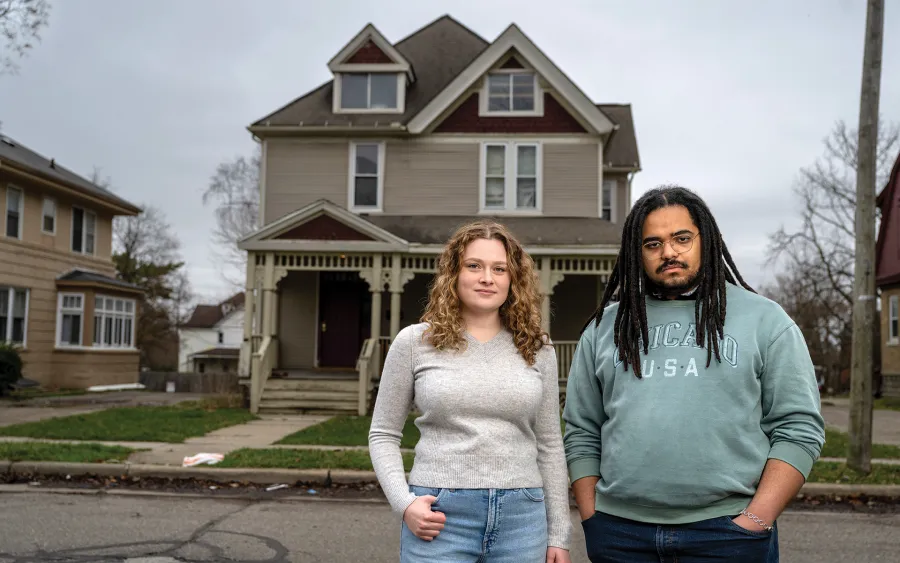
Last fall, a single mother and her 12 children were living in a badly run-down house in Ypsilanti, Michigan, with lead paint flaking off the walls, leaking pipes, asbestos, and a basement prone to flooding. Yet their landlord refused to make improvements.

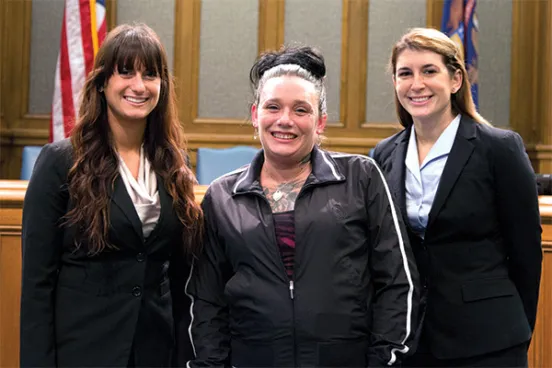
Michigan Law’s Civil-Criminal Litigation Clinic took on the family’s case, and two student-attorneys, King Deas and Abby Flynn, who were then 2Ls, got to work. They filed a complaint against the owner and the management company of the house, and they sought a temporary restraining order requiring the defendants to provide alternative housing for the family.
That issue went to court, where a prominent landlord attorney opposed the motion. But the students argued and won their case, and the family moved into a hotel under much improved conditions.
“This is a great example of the typically unsexy but vital core legal services that our students deliver,” says David Santacroce, longtime clinic director and clinical professor of law. “It’s in the trenches, doing the hard work of keeping people housed.”
Deas and Flynn’s work on the case earned them an Outstanding Clinic Team Award from the Clinical Legal Education Association. More importantly, the students know the experience will serve them well in their careers.
“We were lawyers that semester, which is not an experience that you can get outside of the clinic,” Deas says. “Actually going to the house, collecting evidence, arguing in court. We know how to litigate a case; I think that’s invaluable.”
“We both came to law school straight from undergrad, so we didn’t have a lot of other work experience,” Flynn adds. “Now, going into future jobs, I can say that I’ve stood up in court and argued, I’ve filed briefs, I’ve built a relationship with a client. Every aspect of it will be helpful.”
Debra Chopp, Associate Dean for Experiential EducationOur purpose is to teach law students how to be excellent lawyers through the high-quality representation of clients. It’s a dual mission of teaching the students and serving the community.
The clinical philosophy

The 17 clinics at Michigan Law offer students practical experience while also providing clients with legal help they might not otherwise receive. At the same time, the strength of the program—and its willingness to change with the times—gives Michigan a competitive edge over its peer schools.
“Our purpose is to teach law students how to be excellent lawyers through the high-quality representation of clients,” Debra Chopp, associate dean for experiential education, says. “It’s a dual mission of teaching the students and serving the community.”
Clinics operate in many different areas of law, including advocacy in civil and criminal matters; appeals; administrative and regulatory work; and different forms of transactional law, including entity formation and contracts.
“As a public law school, we exist not only to educate students but to advance the public good. Our legal clinics are one of the most direct and powerful ways we fulfill that mission,” says Chopp, who also is a clinical professor of law and director of the Pediatric Advocacy Clinic.
“The clinics do not compete with the private bar. But that carves out a gigantic space, because there are so many people who cannot access legal services. It gives us the privilege of being able to work with people who would otherwise not have representation.”

Learning real-world law
“The transition from law student to lawyer is radical,” Santacroce says. “You don’t get this experience in any other class. You’re not a lawyer in any other class. This type of education teaches students how to actually practice law.”
For example, S.R., a local man in his 50s, faced serious challenges. Issues with his physical health, mental health, and immigration had all contributed to him owing $12,000 to the Internal Revenue Service. The debt prevented him from obtaining US citizenship and paying living expenses.
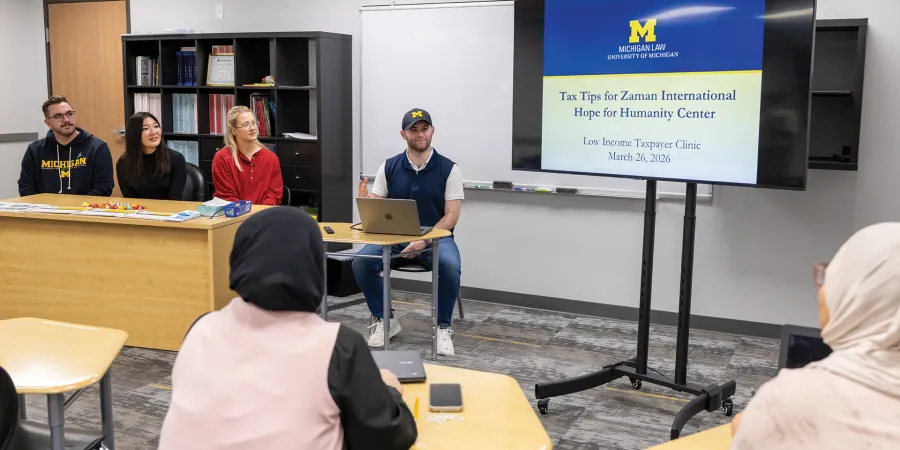
S.R. worked fairly regularly but mostly on a contract basis, making repayment next to impossible. Living in a friend’s garage, he turned for help to the Low Income Taxpayer Clinic, which takes on individual tax cases and also sponsors educational forums for the community.
Richard Cantoral, ’24—who chose Michigan Law in part because of its strong clinical program—was S.R.’s student-attorney. After negotiating with the government, Cantoral succeeded in getting the outstanding debt reduced to $100, enabling S.R. to start getting his life back on track.
“The clinics at Michigan Law teach us how to interact with clients and be of service to them, and they teach the collaborative nature of legal work,” Cantoral says. “Just as important, the clinics do a lot of good work for people who need it.”
Clinic experience has proved very useful for Jacob Abudaram, ’23, who works for the ACLU on disability rights. “Joining the Civil Rights Litigation Initiative (CRLI) as a student was really formative for me, giving me a sense of what it’s like to actually be a civil rights lawyer,” he says.

“When I think back to the experiences in law school that I still draw upon, it’s the entirety of my experience in CRLI. Developing relationships, talking about what’s happening in disability rights, and being in the ACLU universe, I draw a lot from what I learned in the clinic—as well as the actual litigation, getting ready for depositions, writing briefs.
“That experience is the foundation of all the work that I get to do now,” Abudaram says. Every semester, he has returned to speak to current CRLI student-attorneys about disability rights.
The benefits of clinical work go beyond learning specific skills. Mira Edmonds, clinical professor of law and director of the Juvenile Justice Clinic, believes “it reminds students why they came to law school. Legal analysis, which is the focus of doctrinal coursework, is rather different from what most of them have done before. It can be a really hard transition,” she says.
“Clinic work is often invigorating for them, to remember that they want to work with clients, that they want to make a difference for people. They realize how much more there is to being a lawyer and practicing law than what they’ve been focusing on in other classes.”
Serving the community

The clinics provide several different forms of benefits to the broader public. The Michigan Innocence Clinic, for example, has made national headlines as a result of its work to exonerate people in prison who were wrongfully convicted. While not always as high-profile, all of Michigan Law’s clinics provide critical legal assistance to individuals—on countless and varied everyday issues that might otherwise go unresolved.
Clinical Professor of Law Elizabeth Campbell, ’11, was part of the second cohort of students in what is now the Human Trafficking and Immigration Clinic. She helped represent two women from West Africa who had been forced to work braiding hair, unpaid, in New Jersey. The student-attorneys helped the clients apply for visas, and they eventually became US citizens.
Campbell’s experience in the clinic led her to remain after graduation as a staff attorney and then as a faculty member, and she recently became director of the clinic. “What makes the work so meaningful is when you see people where the systems have dehumanized them, not listened to them, not given them a voice—and you can play a role in helping them to feel heard and seen and, even briefly, empowered—that’s the real joy of the work for me,” she says.
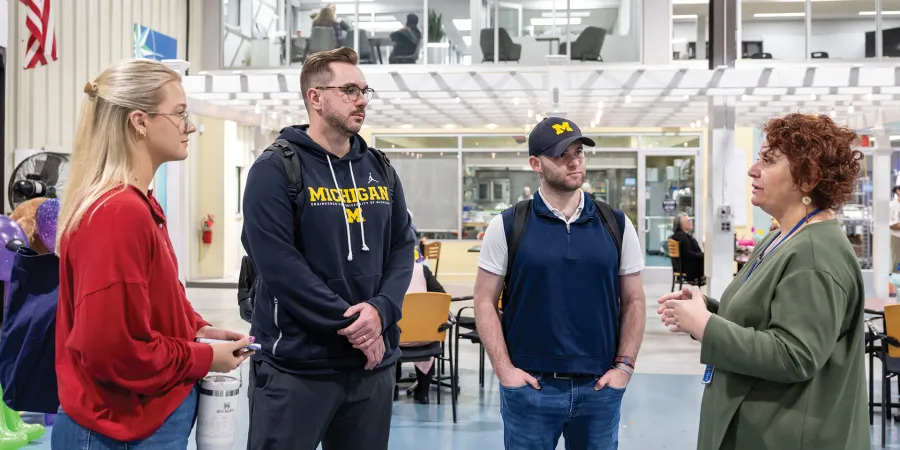

Clinical Professor of Law Nicole Appleberry, ’94—who took a child advocacy clinic while she was a student—is the director of the Low Income Taxpayer Clinic. She says the work of her clinic students makes a huge difference in their clients’ lives.
“For some clients, it might mean being able to buy their insulin, having food to eat, making their rent payments. Sometimes it can be a little more ephemeral. Tax debt can be so scary. They don’t know what’s going to happen, and that filters out into the rest of their life. Achieving some kind of resolution is a great weight off of their minds.”
Meanwhile, some clinics primarily focus on organizations, such as businesses and community groups. In the Zell Entrepreneurship Clinic, around 30 students each term help their clients—largely current U-M students—with legal aspects of start-up business ventures. Like several of the clinics, they collaborate with other schools and colleges across the university to offer their assistance.
“We’re here to support the University of Michigan entrepreneurial ecosystem,” says Tifani Sadek, a clinical professor of law and co-director of the clinic. “A company comes to us with a great idea. They’re starting to put it together, but they don’t have an entity formed. So we help them figure that out.”
Similarly, each semester, the 16 to 20 students in the Community Enterprise Clinic provide legal services to community groups and neighborhood-based small businesses, primarily in Detroit and other disinvested urban areas. The clinic also hosts workshops to discuss common legal issues, and it publishes a blog, Community Empowerment Matters, that addresses legal and policy issues impacting small businesses.
“We’re providing needed legal services that are not provided by the private bar in Michigan, or not provided in the amount that's necessary,” says clinic director Dana Thompson, ’99, who also is a clinical professor of law, director of the Transactional Law Clinics Program, and founding director of the Zell Entrepreneurship Clinic. “There are so many small businesses and nonprofits that require legal services, and a lot of times they just go without.”
Another type of community benefit occurs when clinics take on public policy matters. For example, the Environmental Law and Sustainability Clinic, which celebrated its 40th anniversary in 2023, has worked for several years with the Water Equals Life coalition to draft language for a water affordability legislative package. The legislation was introduced in the Michigan House of Representatives last fall. Student-attorneys analyzed the issues, crafted model legislation, and advised the coalition.

Denise Poloyac, ’83—who took a clinic as a student—now works as associate director of the National Wildlife Federation’s Great Lakes Regional Center, a founding partner of Water Equals Life. “I don’t know that we could have ever gotten to the point that we are at if it weren’t for the work that the clinic has done,” she says.
Finally, the community benefits of clinic work sometimes extend into professional practice. Andrew VanEgmond, ’17, participated in the Pediatric Advocacy Clinic as a student, and now he’s carrying that work forward. A former teacher, he worked as a student-attorney on several cases representing parents of special-education students, and that led him to establish a pro bono practice at his firm.
“Students may be struggling in school, but the answer is not to exclude them from school,” he says. “I learned how to do those cases at the clinic.” Now, he supervises several Dykema attorneys who represent parents of students with disabilities in due process complaints challenging suspensions and expulsions, in partnership with the Student Advocacy Center of Michigan.
(Read about another former student-attorney, Elizabeth Morales, ’20, whose work on a human trafficking pro bono case drew on her clinic experience.)
Evolving and differentiating
While the clinical program has become a cornerstone of most students’ Michigan Law experience, one key to its continuing success is a willingness to grow and change along with the needs of students and clients.
The program started in 1969 with a single clinic. Others were added over the years—including the Veterans Legal Clinic, which aids military veterans; the Child Welfare Appellate Clinic, which represents parents facing the termination of their parental rights; and the International Transactions Clinic, where student-attorneys represent clients around the globe.
Some clinics have shifted their focus over time. The 1L Advocacy Clinic, introduced in 2015, initially concentrated on unemployment cases. Today, its students serve as guardians ad litem for children involved in custody matters before Michigan Circuit Court judges.
Meanwhile, transactional work in general has grown in the clinics as more students express interest. In 2022, the Zell Entrepreneurship Clinic added a focus on name, image, and likeness issues for student-athletes.
Chopp, the associate dean, says that changes to clinical offerings may result from a faculty member’s new idea, or from students showing more or less interest in a particular area. “We look to see what needs in the community we’re not serving,” she adds.
The most recent changes to clinics include:
- The former Human Trafficking Clinic explicitly added immigration to its name, reflecting the wider focus of its work.
- The newest addition to the portfolio, the AI Law and Policy Clinic, opened in January. In this clinic, students employ artificial intelligence tools to improve access to justice, streamline legal processes, and find solutions to systemic issues. In the first term, 18 students worked on a variety of projects, such as helping legal aid lawyers analyze leases to identify unlawful provisions.
- Starting in the fall, the Low Income Taxpayer Clinic will become the Tax and Estate Planning Clinic, adding services to help low-income clients secure basic legal protections that can prevent downstream crises for families and communities.

Keeping the clinic offerings current helps them act as a differentiator for Michigan Law. At the same time, the size and stability of the program set Michigan apart from its peer schools.
An unusually high 80 percent of students take a clinic during their time at Michigan Law. In addition, the school is one of just a small handful nationwide that offers a clinic for first-year students.
Unlike some schools, which offer clinics that are more like externships, most of Michigan’s are true in-house clinics. “The clients are the clients of the clinic, not of an outside entity,” Chopp says. “The vast majority of our clinics are taught by professional educators. They are people who have the dual mission as part of their professional identity to be excellent teachers and excellent lawyers.”
Santacroce—who is also a former associate dean for experiential education—has a national perspective as the founder and president of the Center for the Study of Applied Legal Education. He agrees that the clinical program is a differentiator.
“Our high intensity sets us apart. We’re way on the top end of the national scale,” Santacroce says. “We’re also the only top-tier law school to guarantee a clinic to students who want one. The guarantee, the saturation rate, and the first-year experience really make us different.”
Chopp says the clinics “are of great interest to prospective students. And current students love them. The vast majority of the students speak glowingly about their clinic experience. They love the ability to help people, to feel useful, to learn the skills, to do hard things that they were scared to do on day one. Now they feel like they can do it.
“One of the most powerful aspects of clinical legal education at the University of Michigan Law School is that we have this incredibly high-achieving student body,” she says. “When they come to a clinic and dedicate all that intellectual firepower plus their emotional intelligence to the work, they are doing a tremendous service. It is beautiful to watch them help people and learn along the way.”